Our lazy days of winter break wound down and we worked to get geared up for the new semester, which was set to start on January 20. Our schools ended up getting back into having classes only on Monday, January 24, however, because there were some necessary meetings and discussions about changes our schools would be undergoing this semester and next year.
Georgia’s Ministry of Education has been unveiling a number of different changes and reforms, many of which have been extremely positive and productive, some of which are well intentioned but maybe not entirely thought-out before being implemented, and a small number that have been difficult for us and our local counterparts to understand the reasoning behind. On average, they seem to do a pretty remarkable job bringing up the standards of Georgian schools after nearly two decades of education being underfunded (or non-funded), underdeveloped and overall under-prioritized. That said, there is often a lot of feeling that their reforms and changes are really ambitious but lacking some of the follow-through or direction to make them entirely successful.
My school held an all-hands teachers meeting on January 20 where a lot of the newest reforms were discussed, argued and complained about and railed against. The main difference this semester has to do with a fairly complex funding system that Georgia uses. This has led to a cut in funds for many schools, which school directors are supposed to manage to make sure that students still have all the required classes. There wasn’t, it seems, really a lot of direction from the Ministry, however, on how to “make it work.” What my school did to match the gap in funds was fire teachers and staff (about 20 people lost their jobs) and combine classes (we went from having classes of about 20-25 to having some classes with up to 48 students). Sam’s school managed not to lay off as many (or possibly any) teachers, but cut down the number of hours that all the teachers have (and thus cutting the pay for all of the teachers, instead of having a few lose out entirely). His classes have gotten larger as well.
Everyone was really upset about these changes, understandably, and the semester started off on a sour note. Adding to the troubles is a change in the rule about students that lack Georgian citizenship. Previously, these kids could study at Georgian schools alongside Georgian citizens. Now, however, children with foreign citizenship are supposed to pay a pretty hefty fee to continue studying at Georgian public schools. At my school in this minority region, about 10% of the student body has foreign citizenship. This is causing a huge problem. Lots of families are being forced to make the tough decision of sending their children with Russian or Armenian citizenship to live with aunts or uncles or family members in Russia or Armenia to finish school or trying to come up with a sum that is equivalent to about 4 months’ of a schoolteacher’s salary per child.
All these factors have combined with the cold, wintry weather to make going back to school pretty rough. As the administration of my school tries to clarify details and get exceptions and exemptions to make things more bearable, we’re still without a permanent schedule for classes (this three weeks into the spring semester). It’s going to be a bit of a slog as they work everything out, but I’m hopeful that things will be made a little pleasanter soon.
We got a nice break from all of these school bureaucracy problems this week thanks to two back-to-back Peace Corps trainings. The first training was one that I helped work on and coordinate as part of my work with PC Georgia’s Life Skills Committee (a PC-wide initiative committee that works on health-related topics, and specifically on HIV/AIDS issues). We held a two-day Training of Trainers for any PC Georgia volunteers and their counterparts to discuss ways to introduce and teach healthy living topics in the classroom or in after-school clubs or community organizations. The other committee members and I (funnily enough, the four of us are all married volunteers; one of our PC staff members refers to us as the “married wives committee”) had been working hard on getting things together for this training. It’s a nice feeling of relief to been done with this initiative, especially since we’ve got a lot of other projects that we’ve been working on. One big project done!
After the ToT, all of the Education volunteers and their teaching counterparts had two more days of training to work through issues of how to team teach more effectively and efficiently. It was another very helpful training and nice to see how the other volunteers have worked out strategies to have good working relationships with their counterparts. We’re all very fortunate to have a lot of dedicated, hard-working, patient counterparts, and it was really nice to have some chances to think about ways to make our working relationships that much better.
The trainings were also a huge success on the room-and-board front. We stayed in a pretty swanky training facility in Bazaleti, about an hour north of Tbilisi. Our rooms had tvs with BBC news in English! The facility “restaurant” served lots of tasty food, too, too much of which was eaten on a regular basis. But I just couldn’t pass up the chance to have coffee with milk and bliny and cheese and yogurt and salad and lots more delicious. Who knew that PC service would have so many luxuries?!
Just prior to the trainings, Sam went to Tbilisi for an extra day. He had an interview to be a cross-cultural trainer for outgoing high school exchange students from Georgia to the US as part of the FLEX program. He’s hopeful that he’ll be selected, not the least because his training for the program if chosen would include a week-long trip to Ukraine. Several other volunteers applied, though, so he’ll have to wait to hear back once they’ve reviewed all the applications.
And even though we spend almost all of our time together, while Sam was away (we were apart for slightly over 24 hours), we were given some reminders of why we’re better together. Sam spent a cold night in Tbilisi at the guest house because he didn’t realize there was a blanket in the room. He says that if I had been there, the blanket probably would have been found. I, on the other hand, was tasked with turning off the light to go to bed on the night Sam was away (his side of the bed is closer to the light switch and usually he’s the one reading so he’s the one who’s in charge of turning it off). I hadn’t realized just how ridiculous this was until Sam was away and I, in making my extra lap around the bed after turning off the light, kicked a chair with all my might in the dark. Unfortunately, I haven’t gotten the right language training to say the words I really wanted to say at that point. I figured I’d be fine by the next morning, but instead I had a black-and-blue, swollen, painful toe. It was still bothering me some when I went in for the trainings, so I talked with one of the PC doctors (our doctors are amazing!), who gave me lots of goodies to take care of my toe and got me an appointment for an x-ray after the training if my toe was still bothering me. Luckily my toe is on the mend so I didn’t have to get any x-rays, but I’m still supposed to take it easy for another week (no running for two weeks! I think I might go crazy). Sam was extremely sympathetic when we met up in Tbilisi just before the training, remarking that we really will be one of those old married couples who dies at just about the same time. Not because we’ll be so heartbroken that the other is gone, just because we’ll forget to eat or electrocute ourselves or something similarly stupid without the other there to remind us.
So with all these stories and way too much text and no pictures as yet to reward you for slogging through my way-too-long blog post (I could never do twitter), I’ll leave you with two videos of what has become my new favorite pastime: watching our host sister, Lilit, trying to walk around in my slippers.
Sunday, February 6, 2011

Friday, January 21, 2011
Yerevan, Echmiadzin, and Gori
We decided to take advantage of our last week of winter break to take a trip to our next-door neighbor to the south, Armenia. One of Melissa’s teaching counterparts, Gohar, was going to visit her son and daughter in Yerevan, and kindly invited us to go along. So Monday morning we hopped on the marshrutka and set off. We’re about 15 miles from the border, and even with the stop to get a visa, the trip was not much longer than that to Tbilisi.
That afternoon and evening, we walked around the city with Gohar to get our bearings. The central square (hraperak) was in full holiday regalia, with a big New Years tree, dozens of Santas, kiddie cars, and horse carriages.

On Tuesday, we went to Echmiadzin Cathedral outside of Yerevan, the center of the Armenian Apostolic Church. The cathedral itself is beautiful, and in its museum are all kinds of relics and treasures from the whole of the Armenian Church, including, for example, the spear that's said to have pierced Christ's side.


The grounds were also really nice, and we particularly liked these sculptures, carved into the trunks of still-standing dead trees:

Afterward, we saw another church and convent nearby, and then went to visit Gohar’s sister in the district of “Bangladesh,” so called for its crowdedness and distance from the center. There we had some delicious Armenian food (ishli kufta) and spent a really nice time talking and visiting.
Wednesday morning we visited the Genocide Memorial that crowns a hill overlooking the city. The museum itself was closed, but an eternal flame burns for the victims and a small forest of evergreen trees has been planted by heads of state, governments, organizations, and individuals who have recognized the genocide.

Afterward, we walked around the city some more, visiting the nearly-finished Cascade, a waterfall fountain with a variety of museums and exhibits inside. The water was off for the winter, but I’m sure we’ll be back sometime when the flowers are blooming and fountains flowing.
Chihuly pieces from a gallery inside the Cascade:

From the top of the Cascade, we walked through a park to the statue of Mother Armenia and her rather oversize sword staring protectively toward the West. In this photo it appears that she is about to smack some Ferris wheel riders:

We then made our way to the matenadaran, the Armenian manuscript library. One of the really fascinating things to me about Armenia’s sense of self is the great importance placed on writing and literacy, and the matenadaran is a monument to that value.
Afterward, we headed to the famous Grand Candy shop and cafe for some ponchiki. I don’t know if they were as good as the ones Melissa made, but it was still a fun time.

On Thursday, we went to the Armenian State Museum, which featured a really interesting exhibit on Bronze Age Armenia before marching on through the centuries to almost the present day.
On Friday, it was time to go. We went back to Tbilisi, rather than to Akhalkalaki, so that we could do a little more domestic traveling over the weekend. It happened to be Old New Year (according to the Julian calendar), so we decided to go to visit our first host family in Kortaneti. They have a tradition that will be familiar to my family members of hiding a coin in a loaf of bread – the one whose piece has the coin will have good fortune that year. Looks like 2011 will be grandmother’s year.
On Saturday, we decided to take a day trip to Gori, the birthplace of Stalin. A big statue of old Joe used to stand in the center of town. It was taken down last summer and now there’s a New Year’s tree in its place.
We visited the palatial Stalin museum, which included the house where Stalin was born (itself now housed in a huge stone and marble pavilion) and a hall of gifts to the leader.
The Stalin museum:

Stalin's office recreated:

A gift to Stalin from the workers of an accordion factory:

We also managed to visit the cave city of Upliltsikhe outside of Gori, an ancient site where pre-Christian temples, churches, pharmacies, and the royal residences of the kings of Kartli piled on top of one another. We had the place almost to ourselves (save for a policeman chasing a runaway horse around and looking very like a Keystone Kop), and it was fun braving the high winds and tromping in and out of the caves and marching down the long tunnel to the River Mtkvari.


We were back in Kortaneti for the night and spent some good time with our host family (once again promising ourselves that we’d brush up on our Georgian) before heading back home on Sunday. School was due to start today, but it looks like for pretty much everyone that date has been pushed to Monday. So it’ll be back to work and a new semester of challenges and (hopefully) accomplishments. We’ll keep you posted!
Sunday, January 9, 2011
Happy New Year!
Akhalkalaki rings in the New Year with gusto. The market is jammed in the weeks before with everyone in town and from the surrounding villages stocking up on candy, fruit, drinks, decorations, fireworks, presents, produce and the obligatory whole piglet. Our central park was turned into a meat market, and you could hardly turn a corner without finding a box of live geese or a cow (in whole or in part) waiting to be served up as part of the New Year’s feast. Meanwhile, walking the streets was a nerve-shattering experience as the local youth made full use of the truckloads of cheap firecrackers being sold like chewing gum at every store counter and stall in town. Decorations popped up everywhere – a big New Year’s tree in front of the town’s Culture House was the focus, but lots of people had lights or other decorations up. Every woman in Akhalkalaki was busy cooking in the last days of December, a feat made more impressive by the lack of electricity for 4 of the 5 days leading up to the New Year, and every family lays out a kingly table for the guests. We had (among other things) a whole piglet, chicken, ham, Canadian bacon, cabbage rolls, stuffed grape leaves, half a dozen different salads, two kinds of cake, scads of fantastic (and beautiful) pastries, a wide range of cheeses, nuts, candies, and dried fruit, bottles and bottles of wine, champagne, vodka, champagne, and soda.
One of two New Year's trees in our house
 Every woman in Akhalkalaki was busy cooking in the last days of December, a feat made more impressive by the lack of electricity for 4 of the 5 days leading up to the New Year, and every family lays out a kingly table for the guests. We had (among other things) a whole piglet, chicken, ham, Canadian bacon, cabbage rolls, stuffed grape leaves, half a dozen different salads, two kinds of cake, scads of fantastic (and beautiful) pastries, a wide range of cheeses, nuts, candies, and dried fruit, bottles and bottles of wine, champagne, vodka, champagne, and soda.
 Our Family's New Year's Table (more was to come)

2011 is the Year of the Rabbit
 On the 31st, people tend to go to the church in the evening to light a candle, then go home to greet the New Year with their families. All day long the Russian, Armenian, and Georgian TV channels are showing their own Rockin’ New Year concerts and holiday movies with the same standing as It’s A Wonderful Life or a Charlie Brown Christmas. Shaen and I had been working on our renditions of "Jingle Bells" and "We Wish You a Merry Christmas," with me on guitar and he on drum and (English!) vocals. We gave a lot of concerts over this holiday season, and I think it went really well.
At midnight, there’s the champagne toast and then a general rush for the doors to witness the sometimes alarming and altogether dramatic spectacle of every single household in a city of 10,000 people simultaneously setting off a month’s accumulated fireworks, bottle rockets, screamers, fountains, smoke bombs, sparklers, M80s, and various other pyrotechnics. Not quite to the scale of a DC or Boston Fourth of July, but with a kind of immediacy that a display put on by trained professionals with a fire crew standing by just can’t match.
Then, an hour later, we did it all over again, this time on Moscow time.
Father Winter brings New Year's presents to kids just like Santa Claus on Christmas in America, and Shaen was really excited to find a card game and a miniature foosball table. (He had persuaded his grandmother to give him his present early, so we had already met the laser-blasting, missile-firing, walking, talking robot).

A few days later, Melissa coming back from Tbilisi was able to surprise him with a gift from her mother, which he wore for about 4 days straight (when his parents made him take it off for bed, he got up at 3 am and put it back on).

Lilit was likewise happy to show off her new outfit from the Kuhlman household:

The next day, January 1, the visiting began. Fortified by a hearty breakfast of grape-leaf dolma, we settled in to receive guests, and then set out on our own visits. The next four or five days were a food and visit-filled blur. It was a great chance to spend time with our friends and acquaintances here in town and celebrate with them. We managed to stumble through a few toasts in Armenian, and somehow survived the week without exploding a la Mr. Creosote.
It’s a really nice tradition, though by the end everyone is exhausted. It’s expensive, too; even people who really can’t afford to feel like they have to lay out a lavish table. People shake their heads over the amount of food that goes to waste, and more than one person said that they would prefer a one-day celebration with family and close friends. Still, we were really glad to be here to celebrate the New Year with new friends, and as usual words can’t even express how kind and hospitable everyone has been to us.
Another milestone: today marks 6 months since our swearing in – we’re officially 25% through with our service as Peace Corps volunteers!
Tomorrow we leave for a week-long trip to Armenia with one of Melissa’s teaching counterparts. We’re excited to see our neighbor to the south and we’ll be back with stories and pictures before school starts up again on the 20th.
Happy New Year to all of you reading this, and we hope 2011 brings you all the best!
Thursday, December 30, 2010
Tis the season...
Around town, it's looked like a combination of Christmas and New Years and Sunnyside sometime around the end of the football season. People are going crazy getting ready for the big New Year celebration. We'll post some stories and thoughts on the holiday itself after we live through it (if we survive; given all the powerful fireworks being set off every minute by our third-graders, that's a mighty big if). For now, though, here are some pictures of what has been going on in town as various Festivus activities approached, passed and continue to be celebrated.
The town "square" all decked out in lights

The light display from a different angle

One more look at the town's lights

In our host house, Shaen was in charge of decorating the New Year's Tree
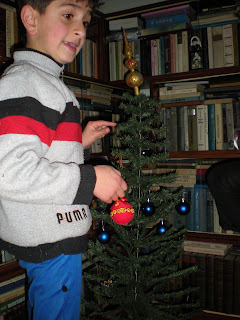
Lilit wanted to do her part to "help" but this often involved undecorating and attempting to smash ornaments

Shaen thwarted most of Lilit's attempts

And he deemed Sam as trustworthy enough to be allowed near the tree

Luckily, Lilit found some other ways to amuse herself

The mountains retained some of the snow that we got in December, but most of the rest has melted away

My school devoted much of the end of the semester to decorating the hallways and classrooms

If only as much effort was put in to homework!

Or as much attention given to listening in class!

Sam's school decorated as well

I proved that I earned my kindergarden diploma with my creative gift wrapping

Then I discovered the gift bags in a store in town

Lilit has continued to be adorable. Here she is appropriately decked out in both a "Father Frost" hat and bunny shirt (commemorating the Year of the Rabbit which 2011 apparently is. Who knew?)

A group of PCVs celebrated Christmas in style with khachapuri and beer in Tbilisi.

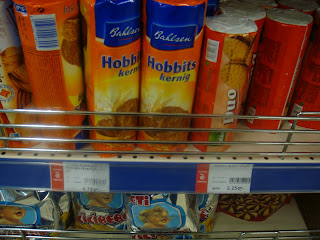
And Sam got the greatest Christmas miracle of all. Turns out you can buy hobbits for only 4.75GEL at the Populi grocery store in Tbilisi.
Hope you all had a very Merry Christmas and Happy Holidays! Enjoy what's left of 2010!
The town "square" all decked out in lights

The light display from a different angle

One more look at the town's lights

In our host house, Shaen was in charge of decorating the New Year's Tree

Lilit wanted to do her part to "help" but this often involved undecorating and attempting to smash ornaments

Shaen thwarted most of Lilit's attempts

And he deemed Sam as trustworthy enough to be allowed near the tree

Luckily, Lilit found some other ways to amuse herself

The mountains retained some of the snow that we got in December, but most of the rest has melted away

My school devoted much of the end of the semester to decorating the hallways and classrooms

If only as much effort was put in to homework!

Or as much attention given to listening in class!

Sam's school decorated as well

I proved that I earned my kindergarden diploma with my creative gift wrapping

Then I discovered the gift bags in a store in town

Lilit has continued to be adorable. Here she is appropriately decked out in both a "Father Frost" hat and bunny shirt (commemorating the Year of the Rabbit which 2011 apparently is. Who knew?)

A group of PCVs celebrated Christmas in style with khachapuri and beer in Tbilisi.

And Sam got the greatest Christmas miracle of all. Turns out you can buy hobbits for only 4.75GEL at the Populi grocery store in Tbilisi.

Hope you all had a very Merry Christmas and Happy Holidays! Enjoy what's left of 2010!
Wednesday, December 22, 2010
Runnin Down a Dream
If you're reading this blog, then you probably already know that I have a fairly serious running addiction. I was insane enough to make one of my last activities in the States before heading out for the Peace Corps a marathon (and a pretty spectacular and fun marathon at that!). Washington/Northern Virginia was the perfect place for me, with its crazy running population, miles and miles of nice running trails and series of races held throughout the year. It was one of my worries that I might have to give up running during PC. We packed our running things to bring with us, uncertain as to whether we'd actually be able to get any use out of them. Running tends to be a fairly odd thing in some places in the world (some parts of the U.S. included), and weather and other variables can be big hindrances to getting in a run.
On the weather front, Sam and I have been extremely fortunate so far to have had pretty much spectacular weather for outside exercising. Sure, we've had some cold, cold mornings and there's been some snow and ice, but we haven't had hardly any rain or anything that's been insurmountable. So weather hasn't been a huge factor.
Places to run haven't been too much of a problem either, thanks to all the street paving projects around town (which make it so that even when it does rain we've got blacktop to run on). When we've gotten snow and ice, we can go to the "soccer stadium" in town and run on the single-track path that loops lopsidedly around it for roughly a quarter of a mile. There's also a park not far from our house that is 1/5 of a mile around. So we have places to run.
Our biggest hassle is the stray dog (and often owned dog) problem. Dogs just roam around, alone or in packs, unhindered by fences or chains or dogcatchers. They make for some unpleasant moments when we come upon one or several of them unexpectedly, whether we're out running or just walking around town. We usually spot them in time to slow to a walk and grab a rock, and so far (knock on wood), we've been able to avoid any serious run-ins. We aren't too worried about the dogs, in any case, since there are always plenty of rocks to threaten them with and since we've already had to get the first three shots in the rabies shots series. So dogs are a problem, but (at least for now) not too much of a problem.
We do get some odd looks and remarks from locals as we run. Mostly these have been easy to shrug off, though, and we don't really see it as a discouragement.
That means that we don't really have too many legitimate excuses against running in the morning. We've been decently good about getting in about 5 morning runs a week, usually for about 3 miles or so. It's always a little fun and rewarding to see people's eyes pop out of their heads when we tell them we've run 5 kilometers and that it's something we do regularly. Today we had a man shout at us "Go sportsmen!" as we looped around the park.
I may not be in my peak marathon performance shape, but I sure am glad to have been able to continue running. Nothing I know helps me better beat stress than a nice run (or even a difficult, terrible run for that matter). And given the extremely large quantities of food we eat every day, running has at least helped keep the weight gain down (although not entirely eliminated it...). So as we approach the end of 2010 and the beginning of 2011, I'm looking forward to another great year full of running. I hope you all can keep running and have fun, too!
On the weather front, Sam and I have been extremely fortunate so far to have had pretty much spectacular weather for outside exercising. Sure, we've had some cold, cold mornings and there's been some snow and ice, but we haven't had hardly any rain or anything that's been insurmountable. So weather hasn't been a huge factor.
Places to run haven't been too much of a problem either, thanks to all the street paving projects around town (which make it so that even when it does rain we've got blacktop to run on). When we've gotten snow and ice, we can go to the "soccer stadium" in town and run on the single-track path that loops lopsidedly around it for roughly a quarter of a mile. There's also a park not far from our house that is 1/5 of a mile around. So we have places to run.
Our biggest hassle is the stray dog (and often owned dog) problem. Dogs just roam around, alone or in packs, unhindered by fences or chains or dogcatchers. They make for some unpleasant moments when we come upon one or several of them unexpectedly, whether we're out running or just walking around town. We usually spot them in time to slow to a walk and grab a rock, and so far (knock on wood), we've been able to avoid any serious run-ins. We aren't too worried about the dogs, in any case, since there are always plenty of rocks to threaten them with and since we've already had to get the first three shots in the rabies shots series. So dogs are a problem, but (at least for now) not too much of a problem.
We do get some odd looks and remarks from locals as we run. Mostly these have been easy to shrug off, though, and we don't really see it as a discouragement.
That means that we don't really have too many legitimate excuses against running in the morning. We've been decently good about getting in about 5 morning runs a week, usually for about 3 miles or so. It's always a little fun and rewarding to see people's eyes pop out of their heads when we tell them we've run 5 kilometers and that it's something we do regularly. Today we had a man shout at us "Go sportsmen!" as we looped around the park.
I may not be in my peak marathon performance shape, but I sure am glad to have been able to continue running. Nothing I know helps me better beat stress than a nice run (or even a difficult, terrible run for that matter). And given the extremely large quantities of food we eat every day, running has at least helped keep the weight gain down (although not entirely eliminated it...). So as we approach the end of 2010 and the beginning of 2011, I'm looking forward to another great year full of running. I hope you all can keep running and have fun, too!
Saturday, December 18, 2010
We wish you a happy...
It’s been a while since we’ve posted, and that’s mainly because life has settled into a pretty normal routine lately. We’ve had six uninterrupted weeks of school, with one more to go before the holiday. Students are busy getting their classrooms decorated for New Year – pretty much everything we do for Christmas, Georgians and Armenians do for New Year. We’ll have more to say about the holiday once we’ve actually experienced it. For now our host brother has been eager to get the New Year’s tree up, lights have been appearing in stores and downtown, and Melissa’s been busy teaching Christmas carols to her English clubs. I haven’t managed to teach any songs yet, but one of my classes, under their homeroom teacher’s direction, has learned “We Wish You a Happy New Year” (Lyrics: “We wish you a happy New Year/ We wish you a happy New Year/ We wish you a happy New Year/ …and a happy New Year!”)
A few things worth mentioning have happened – we had a visit from fellow PCV Christopher (tweets here and blogs here), during which we traipsed around Akhalkalaki, had some more Rose Dolma, and decided not to walk over the following bridge on a chilly winter’s day (thanks, safety and security training!):

Rose Dolma (kind of like a cross between lasagna and meat dumplings)

We finally started Georgian lessons again two weeks ago. It’s awfully difficult getting back to it, but we’re glad to have the chance to rescue what we still remember and start brushing up.
We had our first real snow last week; it’s mostly gone from the town now (though now the snow’s falling hard as I type), but it’s left its mark on the mountains all around us, and, treeless and scrubby as they are in summer, they really benefit from the snow. We’ll have some pictures up soon, hopefully from one of our morning runs, where we’re treated to the sun rising over the now snow-draped Mount Abul (Apollo). Even my references to Coors Light commercials can’t quite ruin the grandeur.
And here’s just a little slice of life here in town. I’ve sent some letters from my students to students in Oklahoma participating in a program called World Wise Schools that matches Peace Corps volunteers with American primary and secondary school teachers to share experiences and information. I thought I’d jot down my impressions of a visit to the local post office a few weeks ago:
The ladies sit in a little room in the corner of the old Soviet post office. The main office is deserted, the long counters and queuing space gathering dust. You can see the rack where envelopes once where, and space on the walls for signs or posters. Now there are just a few cheap Xeroxes offering optimistic claims of working hours and urging faith in the unseen presence of “electronic mail.” One of the heavy metal doors behind the counter is open – it is a small office or storage room currently filled with shoes and boots, apparently holding stock for one of the vendors at the bazaar outside. The other door is closed, and behind this door is the little cloister of the Akhalkalaki postal service. The room is warm and cluttered with stacks of papers, some of which seem not to have been moved for years. A little cast iron stove cracks from time and its heat fills the room like a grandmother’s corner by the home stove. Pumpkins take up a good bit of the free space, arranged on the floor or perched on sills below dim windows. No one seems to send much – an international letter is an all-hands project, and you sit by the fire and chat while they examine the chart for the rate (5 lari) and laboriously fill out the little receipt and its carbon copy. They are friendly and the whole experience feels like a social call; the absence of a line of customers doesn’t mean you get out of the Akhalkalaki post office sooner than you’d escape one in downtown Washington, though the wait is of a different sort. But finally the receipt is in your pocket and the letter vanishes into the stacks of paper and the same realm of faith where, perhaps, the electronic mail resides, and you’re out again through the big echoing concrete room and into the market street with is dull December air and warm December sun.
We’ll be in Tbilisi next weekend for Christmas. December 25th isn’t a holiday here – like I mentioned, New Year is the big holiday, and while Christmas itself is celebrated, it’s on the Orthodox date of Jan. 6/7. It’s the toughest time to be away from family and friends at home, so we’ll be seeking Christmas cheer in the company of our fellow Peace Corps volunteers. So, if we don’t get to the blog again before the 25th, here’s wishing anyone who might be reading a Merry Christmas! The snow's falling fast here, and a Charlie Brown Christmas might just be in order.
Wednesday, December 1, 2010
World AIDS Day
December 1st is World AIDS Day. Many PC volunteers tried to think of ways to incorporate an HIV/AIDS lesson or activity into their work today, since the holiday would provide a good segue into a fairly difficult subject.
Here in Georgia, the HIV/AIDS rate is fairly low. There are only about 4,000 cases in the country (with a population of about 4 million). But there is still a lot of concern about the possibility of an explosion in the HIV/AIDS rate here due to a number of risk factors. First, the region as a whole (made up of the former Soviet Union and eastern Europe) has the world's fastest growing rate of infection. Second, there is a lot of exchange between the Georgian population and some higher risk countries, like Ukraine and Russia (lots of men work abroad in these two countries for part of the year and then come back to their families in Georgia for a few months). Many in Georgia catch the disease from IV drug use. Also, commercial sex workers are also among the most affected population here (and at least according to anecdotal evidence, there seems to be a fairly high acceptance of men frequenting prostitutes and brothels here in Georgia). On top of this, there is very little (to no) education for most of the population about risk factors, how the disease is spread and how to protect oneself. It all adds up to a potential for a disastrously quick spread of HIV/AIDS.
One of the big hurdles to teaching people about HIV/AIDS is that sex is a taboo subject here. The society is conservative and so discussing a disease that, in most of the world, is spread primarily through unprotected sex is not easy. To try to be culturally sensitive and discuss this kind of topic poses a pretty big conundrum.
I decided to give it a try, though, and to see if I could do something at my school, either as part of one of my after-school English clubs or with the older students during class. I found an ally in one of the deputy directors, a woman who also doubles as an English teacher (most of our assistant principals also work as teachers). She immediately jumped on board and encouraged me to teach a lesson to as many of the students as possible from grades 7-12. Then she surprised me today by preparing a bulletin board in the school's main hallway with some information and pictures related to World AIDS Day.
My school's hallway bulletin board display

One of the other volunteers found a great video resource (available for free at http://www.teachaids.org/tutorials.php) about HIV/AIDS. The language is accessible enough that I thought, with some translation, the students at my school might be able to handle it. The video is also done in a very culturally sensitive way, giving lots of useful, accurate information without being too graphic or explicit. I pulled together some other materials and made a whole bunch of red ribbons to distribute to the kids (Sam joked that, with all the ribbon and pins and making of hundreds of bows, it felt like we were getting ready for a wedding).
All Ready to Present

Then today for five 40-minute class periods, I met with all the English classes that were scheduled for today, from 7th through 12th grades. In all there were 187 students and 6 teachers that participated. Surprisingly to me, I was able to translate all the difficult words and ideas with only a few grammatical stumbles (who knew I had so much active vocabulary in Russian on the immune system and ways of transmission and prevention being the best defense? If only I didn't always get tongue-tied on the word for "needle"). And the kids understood a lot from the video. I had some really great questions from some of the kids (like "Can you get HIV from a mosquito?" and "Are HIV and AIDS the same disease?") and had only a minimal amount of snickering and giggling when the discussion was about sex.
I kept the discussion off sex for the most part. At least for a first attempt at starting to educate the kids about HIV/AIDS, I wanted to make sure they had some basic facts and had a good grasp of what the disease is. Also, since a lot of transmission in Georgia is due to IV drug use, I focused a lot on that, since I figure that is both culturally sensitive and culturally appropriate. It's a start, at least, and might open the way for the more taboo subjects to be covered in the future.
Giving the Presentation

All in all, despite being nervous about how the students would take the information and what kind of reaction my presentation/lesson would get from the school's director and other teachers, I think everything went really well. I think it is a bit risky to try to talk about HIV/AIDS in schools here because as PCVs we don't want to alienate ourselves in our communities or gain reputations as being troublemakers. But I also think that it's a risk worth taking, and I'm definitely excited that my attempt seemed to pay off. Hopefully, I'll be able to work in some more HIV/AIDS and general health related education projects throughout my time here.
Here in Georgia, the HIV/AIDS rate is fairly low. There are only about 4,000 cases in the country (with a population of about 4 million). But there is still a lot of concern about the possibility of an explosion in the HIV/AIDS rate here due to a number of risk factors. First, the region as a whole (made up of the former Soviet Union and eastern Europe) has the world's fastest growing rate of infection. Second, there is a lot of exchange between the Georgian population and some higher risk countries, like Ukraine and Russia (lots of men work abroad in these two countries for part of the year and then come back to their families in Georgia for a few months). Many in Georgia catch the disease from IV drug use. Also, commercial sex workers are also among the most affected population here (and at least according to anecdotal evidence, there seems to be a fairly high acceptance of men frequenting prostitutes and brothels here in Georgia). On top of this, there is very little (to no) education for most of the population about risk factors, how the disease is spread and how to protect oneself. It all adds up to a potential for a disastrously quick spread of HIV/AIDS.
One of the big hurdles to teaching people about HIV/AIDS is that sex is a taboo subject here. The society is conservative and so discussing a disease that, in most of the world, is spread primarily through unprotected sex is not easy. To try to be culturally sensitive and discuss this kind of topic poses a pretty big conundrum.
I decided to give it a try, though, and to see if I could do something at my school, either as part of one of my after-school English clubs or with the older students during class. I found an ally in one of the deputy directors, a woman who also doubles as an English teacher (most of our assistant principals also work as teachers). She immediately jumped on board and encouraged me to teach a lesson to as many of the students as possible from grades 7-12. Then she surprised me today by preparing a bulletin board in the school's main hallway with some information and pictures related to World AIDS Day.
My school's hallway bulletin board display

One of the other volunteers found a great video resource (available for free at http://www.teachaids.org/tutorials.php) about HIV/AIDS. The language is accessible enough that I thought, with some translation, the students at my school might be able to handle it. The video is also done in a very culturally sensitive way, giving lots of useful, accurate information without being too graphic or explicit. I pulled together some other materials and made a whole bunch of red ribbons to distribute to the kids (Sam joked that, with all the ribbon and pins and making of hundreds of bows, it felt like we were getting ready for a wedding).
All Ready to Present

Then today for five 40-minute class periods, I met with all the English classes that were scheduled for today, from 7th through 12th grades. In all there were 187 students and 6 teachers that participated. Surprisingly to me, I was able to translate all the difficult words and ideas with only a few grammatical stumbles (who knew I had so much active vocabulary in Russian on the immune system and ways of transmission and prevention being the best defense? If only I didn't always get tongue-tied on the word for "needle"). And the kids understood a lot from the video. I had some really great questions from some of the kids (like "Can you get HIV from a mosquito?" and "Are HIV and AIDS the same disease?") and had only a minimal amount of snickering and giggling when the discussion was about sex.
I kept the discussion off sex for the most part. At least for a first attempt at starting to educate the kids about HIV/AIDS, I wanted to make sure they had some basic facts and had a good grasp of what the disease is. Also, since a lot of transmission in Georgia is due to IV drug use, I focused a lot on that, since I figure that is both culturally sensitive and culturally appropriate. It's a start, at least, and might open the way for the more taboo subjects to be covered in the future.
Giving the Presentation

All in all, despite being nervous about how the students would take the information and what kind of reaction my presentation/lesson would get from the school's director and other teachers, I think everything went really well. I think it is a bit risky to try to talk about HIV/AIDS in schools here because as PCVs we don't want to alienate ourselves in our communities or gain reputations as being troublemakers. But I also think that it's a risk worth taking, and I'm definitely excited that my attempt seemed to pay off. Hopefully, I'll be able to work in some more HIV/AIDS and general health related education projects throughout my time here.
Subscribe to:
Comments (Atom)