Khertvisi Castle, Khertvisi, Georgia

Monday, November 21, 2011

Thankful for the All Volunteer Conference


Last week, Sam and I missed out on most of the school week (darn!) in order to attend the All Volunteer Conference. More than just a clever name, this is indeed a conference that gathers all of the Peace Corps Volunteers in country in one place. Surprisingly, we only have this once-a-year conference where we're all together. Other gatherings tend to be for smaller groups, so although we do see a lot of each other through the course of PC, we don't usually see each other in one big group. The AVC is great, though, for other reasons. We've got a full schedule: we go over our safety and security plans, we elect new members to PC committees, we have a half-day of PCV-led sessions, we spend a lot of time getting to know each other better, and, most importantly, since this conference is always held in November, we prepare and eat Thanksgiving dinner.

This year's safety and security section was interesting. It was very clearly and directly shaped by the "scandals" in the press over the last year, regarding PC's handling of sexual assault and rape over the years. We were sent emails and links to news stories from America by our country director when all this was in full swing last spring and summer (when there was lots of news about the congressional hearings Peace Corps had regarding how the organization has handled cases of rape or sexual assault). But even though we read these and we're in Peace Corps, it seemed far away; maybe we just haven't seen or heard as much as folks at home about it, or maybe it just seems unthinkable when it hasn't been my experience. It's hard to imagine a PC post being anything but extremely helpful, caring and serious in any scenario, but especially in these worst-cases.

The congressional hearings have had an impact, regardless on how connected I feel to it all, on PC operations worldwide. Over the summer PC staff from all over the world had to attend new training seminars on how to respond to rape or sexual assault, how to prevent it and how to ensure that PCVs are kept safe. Our safety and security sessions this year were handed down as a direct result of those trainings and orders from DC. The people presenting sessions to us had to read from a script to make sure that every post conveyed the same information. Our staff and safety and security council members did a great job keeping the information interactive and interesting, but it was an odd departure from last year's safety and security session, which was much more focused on Georgia-specific issues and concerns that our volunteers have. Don't get me wrong-- it's not that I don't support working to prevent sexual assaults on volunteers; quite the opposite, I think this is an important topic to discuss. Really, I mostly just found it weird that Washington was sending scripts around to posts to teach us about safety. Aside from maybe our mothers, I don't think there is any group of people anywhere that worry more about our safety and security than our PC Georgia staff, and I don't think anyone (including our mothers) has more realistic, feasible, Georgia-appropriate, actionable plans in place for keeping us safe or responding in cases when needed.

So that was the safety and security component of the conference. (Last year, we did a half-day simulation of how to respond if the various stages of our Emergency Action Plan are implemented, given different degrees of complication. It was, to say the least, a different atmosphere.)

All Vol isn't all somber and scripted, though. We elected new members for our PC committees. The Life Skills Committee gave our presentation on what we do and what sorts of members we were seeking. We got a lot of great applications for our open positions and had a tough choice to make in winnowing down to just the three slots. I think we got some great new additions, though, and I'm looking forward to all the work we'll do together in the coming months!

The last day of the AVC is spent working on what we call "Concurrent Sessions." These are PCV-led short sessions (45 or 90 minutes) in which we can learn about ongoing projects that PCVs are looking to hand off to new volunteers, share tips on teaching or working in the Georgian context, talk about resources we've created or just have some fun. Last year I attended all the concurrent sessions, getting more and more excited about all the projects I'd be able to get involved with and work on. This year, I was on the other end, presenting some of the sessions and looking to stir up interest among G11s in the projects I've worked on and would like to see continued.

The AVC culminated in the most important session of all: Thanksgiving Dinner. Sam helped head up the "Thanksgiving Dinner Committee" for the second year. He spent every spare moment at the conference in the kitchen, making friends with the Georgian kitchen staff at the conference center, stirring soups, peeling apples, making biscuits and supervising ingredients lists and organization. Last year's meal was delicious and hard to top, but this year's took the cake. Everyone loved everything. The Ambassador came again and specifically complimented Sam on the biscuits (that should translate into a future job offer, right?) and there really weren't nearly as many leftovers as there should have been, which means everyone ate well past the stuffed point. (I personally had a moment of glory when I ate a completely unnecessary extra piece of pumpkin pie with my hands when the plates and silverware had run out.) Especially considering the limitations in the kitchen (it's seriously worse than a Top Chef challenge), the food was fantastic and a really welcome change from the usual fare.

Lacey, working on some pie
Lots of cooks, not enough ovens or burners
My plate(s) were well laden and delicious
No small task, feeding the PC crew!

Now we're back to school, but a wonderfully timed Georgian holiday gives us a day off on Wednesday this week. It's almost Thanksgiving, and I feel like we've got a whole lot to be thankful for. We hope you all have a great holiday and can enjoy and appreciate your dinners as much as we were able to!

Saturday, November 12, 2011

Wrapping Up, Wearing Out

We’ve had a busy couple of past few weeks. We've been trying not to get worn out with the full swing of school, battling the full-fledged winter weather and finishing up the projects we started over the summer.

Sam held a training for his teaching counterparts on using the new technologies he was able to help them get and set up as part of the grant he won for his school. (He even was able to convince his counterparts to come in to school on a weekend for the training!) His classes have been able to benefit from the new English classroom, gaining the joy of hearing all about Mr. Jolly, a major figure in the new lower-grade English textbooks. He has had some frustrations and setbacks in the project implementation, but even with these difficulties, it seems that all of his counterparts are getting into using the equipment. Further, it sounds like the ability to use the AV components of the textbooks (however diabolically evil some of the songs or jazz chants may be) has really been a boon for the students. Sam should be able to finish up all the final reporting paperwork for his grant project soon and be able just to work to see that it continues to be used and useful.

I’ve been working to wrap up my grant-recipient project that started over the summer, too. Since late July I have been holding a series of training sessions on various women’s health topics for a group of women and girls who consistently came to my fitness club. The trainings were all based on the peer education model and with the goal of making all of the participants peer educators, so they could then in turn share the information with their friends, families, relatives and neighbors. I envisioned it as a fairly simple project. I’d get the women together, show them one of the lectures from the Health Education Lecture Series, run through an activity with them from our Companion Guide or one of the other resources the Life Skills Committee has and that would be that. Ten trainings would be no problem to just knock right out.

Marianna, leading one of the training sessions

From the very beginning this plan was a little flawed in its over-ambitious-ness, I think. I expected to start a training project right in the middle of summer vacation season, to keep the same 11 females interested and attending and available for TEN hour- to hour-and-a-half-long sessions. Sheesh.

More training
The women were great, really, and the keeping-their-attention part of this project wasn’t a problem. They all seemed so interested and starved, actually, for accurate, reliable, easily available health information that there was no trouble getting and keeping them engaged. The training sessions themselves were admittedly a fair bit of work to prepare for, but I had an amazing, fantastic, remarkable counterpart, my friend Marianna, to help me present everything, organize everything and get through everything. The scheduling issue was an issue, but it was an issue in part because of my own decision to take a long vacation in August, as well as because of the usual hustle-and-bustle that September and back-to-school and potato harvest usually bring.

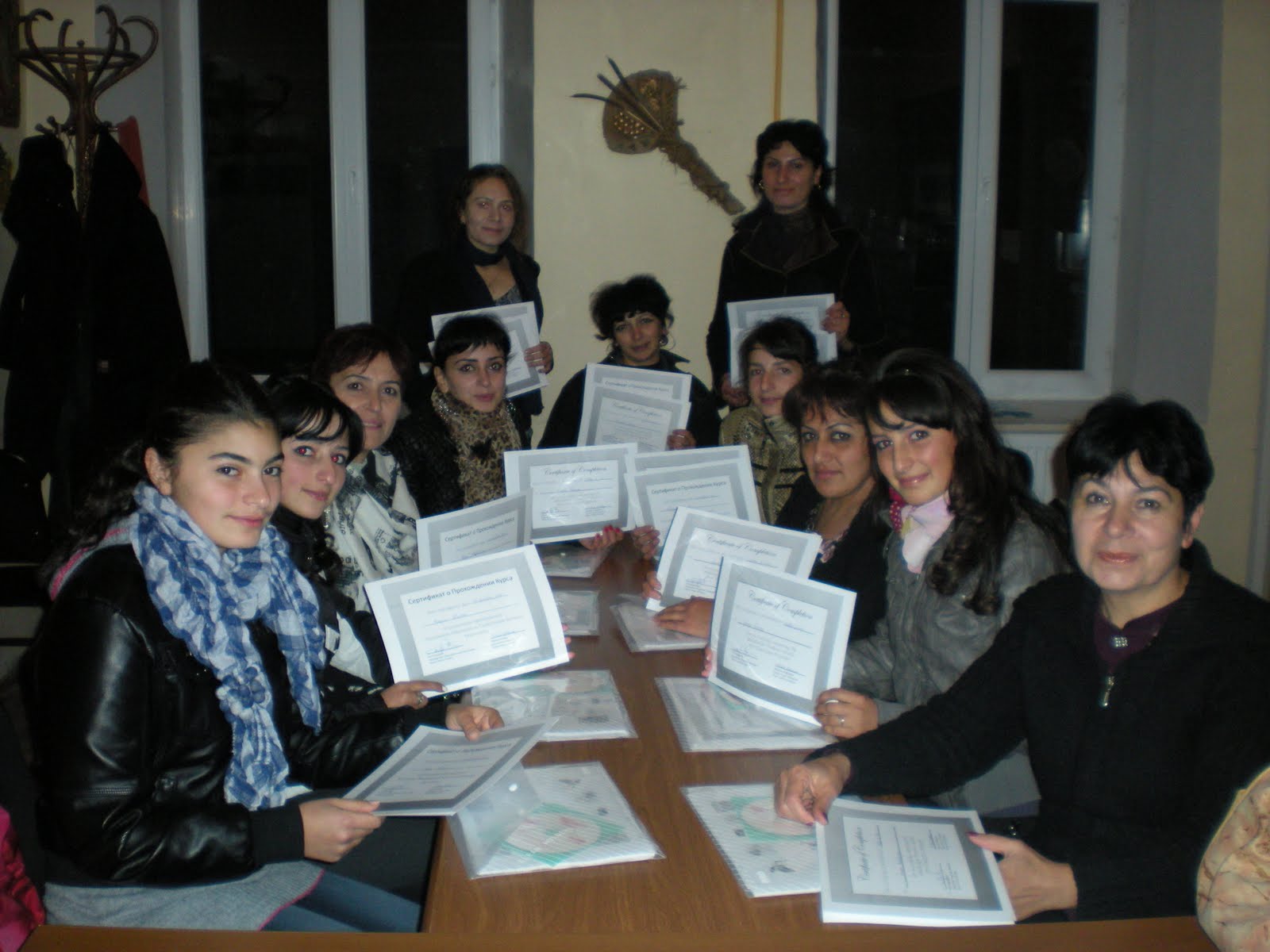
Everyone with their certificates at the end of training

So it took us from the end of July through the end of October, but Marianna and I led 10 hour-plus-long sessions in which we taught our group about nutrition and physical fitness, emotional health and self-esteem, hygiene and communicable diseases, peer education, women’s health, reproductive health and STDs, HIV/AIDS, diabetes, high blood pressure and heart disease, and taking health peer education into the community. The women in the group shuffled around their busy schedules to attend, and all came to nearly every session. They all said they were sad to see the trainings end, but they learned a lot, and I’m really proud of them and grateful for their hard work and dedication.

Their roles as peer educators in our town (the goal I had in mind from the get-go) got a head start and a boost through some luck and some leftover money in the VAST budget. I was able to get an addition to my initial grant to take a group of women to a health clinic an hour’s drive away, where women aged 25-60 can get free gynecological exams and those aged 40-70 can get free mammograms. The clinic’s facilities and equipment were paid for and donated through American and European organizations and donors and everything is state-of-the-art, and no one in Akhalkalaki had ever heard of it. As their final assignment for the training, the women had to run a peer education session on women’s health for up to three other women, then they had to bring those women with us to the clinic for checkups. I expected a group of about 30 (of which 11 would be the original program participants). Instead, I took 43 women on two days last weekend for a full day of screenings. It was incredible, to be able to see how the women from the training program stepped up and helped get enough other women over their fears of doctors or traveling to another town.


Director of the Democrat Women's Organization in Akhaltsikhe, Marina, giving a presentation to the group of women before the health screenings began

The grant money made it possible for me to get a bus both days for transportation, to give the organization an honorarium for providing their services on days when they normally are closed (they usually only work Monday through Friday, but opened on Saturday and Sunday to accommodate the size of our group and to be dedicated just to us), and to buy coffee, tea, cookies and lunch for all the ladies. It was a small grant overall (the total budget for both the training and the trips was just around $1800), but I think it had a big impact. And as we get closer to closing our service here in Georgia (just under 8 months to go!), it’s boosts like these projects that really help us feel like we’ve been doing the right thing.

The group of women, waiting for their health screenings

And even though the clock is starting to tick and our PC service is starting to wrap up, we're both excited about trying to get in a few more projects and activities. I think we've got some final bursts of energy (and enough time left) for another few initiatives. We'll try to keep you posted on what we're up to, and not get too caught up in the whirlwind of our last bit of Peace Corps.

Wednesday, October 26, 2011

October in Kakheti

A week ago, with winter closing in, we decided to act on a longstanding plan to visit fellow volunteer Kelsey Olson in Kakheti, Georgia’s wine country in the west. We had been in the region before, and Melissa had even been to Kelsey’s village of Apeni, but never in autumn.

It’s a long road out from Akhalkalaki, with some errands in Tbilisi (stacks of grad school application supplements, a bazaar bag full of books for my English resource room, and various materials for Melissa’s training project) in between. We got in about sunset and went straight to a supra for a departing TLG (Teach and Learn with Georgia) volunteer. Melissa and I joke that we’re about the only volunteers in Georgia who sit around saying, “You know, I could really go for some khachapuri right now.” So it was great to pull right up to a feast of khachapuri, khinkali, and all the other Georgian delicacies we miss up here on the Javakheti plateau.

The next day , we decided to head up to the Lagodekhi National Park, where we’d heard of a really pretty three-hour hike up to a waterfall. It was a gorgeous day for it, warm but not too hot, and we walked along a riverbed, gradually climbing and occasionally taking detours into the woods, with the hills around turning their autumn colors (a few weeks later than Akhalakalki).


A really nice hike, although our luck ran out at the third river crossing. A flood had knocked down the crossing, and all that was left was a nice round log precariously poised over the rapids.

We started to try (well, Melissa did), but we decided, in the interest of life and limb, to quit before halfway. We had lunch and enjoyed the walk down, wishing we’d made it all the way up, but not regretting the time.


In the afternoon we walked out in the huge garden behind Kelsey’s host grandmother’s house. All kinds of fruit trees, vegetables, and especially grapes. We were coming to the end of harvest time, and the wine would be coming soon, but in the neighbor’s yard there were still acres of white grape vines to be harvested, and Kelsey was volunteered to help the next day.


Unfortunately, we had to leave in the morning to make our long trek back (stopping to pick up my metric ton of textbooks to (mostly) finish off my English resource room), so after one more night of celebratory khinkali, Sporcle quizzes, and homemade root beer, it was time to bit farewell.

But Kakheti in the fall is the kind of place you want to go back to.

Monday, October 17, 2011

Apples and Pears and Plums, Oh My!

One of the biggest benefits (and, at times, one of the biggest downsides) of living here has been the shocking impact of seasons. While we may hear in America that it's better to buy foods in season or that fruits and vegetables taste better (and are cheaper) in season, I know that back at home I wasn't always in tune with what produce had its season when. Our reality of raspberries in January, apples in March and squash in June means that we don't really always see what foods are supposed to be in season at a particular time.

Here, we don't have the luxury of picking up a carton of strawberries imported from Chile in mid-winter. We get strawberries for a handful of weeks in May-June. They are absolutely delicious then, but blink and you miss the season. And, nice as it is to eat in season, I do miss eating fresh (or even frozen) berries whenever I want them.

Drying apples and pears
But nature rolls on and seasons dictate most of what we eat here. (There are some imports and greenhouse-grown foods, so we can get tomatoes year-round, but most people agree that these aren't as yummy as fresh, in-season produce.) We have an interesting rotation of fresh fruits and veggies during the late spring, summer and fall, which is something I hope to be more aware of when we get back home. Late winter and early spring are the "lean season" for fresh produce, though. People have to stock up on "putting up" products to help get through this period.

Right now we're in the heart of apple, plum and pear picking seasons in Akhalkalaki (other parts of Georgia are just winding down the grape harvest and persimmon gathering is starting to get under way as well). Now that all the potatoes have been harvested, people have turned the brunt of their attention to these fall fruits. This means that we've had lots of really delicious crispy fruit in the past two weeks or so, and that canning season is in full swing.

Picking apples with our host family (and neighbor)

Two of the most common jams made here in Akhalkalaki each fall (as far as we can tell) are an apple-butter-like jam and a plum butter, called pelvar. Pelvar purists will say that it's best not to add sugar to the plums as they cook (since they're already an incredibly sweet plum variety) and because it's better to add a certain kind of sweet, green pear instead. Jams and jellies are often teeth-rotting sweet here, so a "small amount" of sugar is usually added even by those who say they don't add sugar (it wasn't much sugar! Only one kilogram!).

Sam spearheaded the pelvar making in our household this fall, thanks to some miscommunication, his push-over tendencies and pure, unadulterated manipulation. He enjoyed it (mostly), but it is excruciating work. Luckily, we found a slow-cooker recipe for making plum butter that we'll be more likely to try back at home.

Early on in the jam-making

After it got too dark and too cold to continue outside over the fire, Sam finished up inside
Some of the finished product, getting packed up for storing

This year has been a banner harvest for apples and plums and pears, though, so we've seen lots of people doing the back-breaking work of slowly stewing fruit over a fire. Others have been drying fruits in the sun to save for winter (usually, they boil the dried fruits during the "lean season" for fresh produce to make a vitamin-rich compote). All the fruit has added to a generally beautiful fall atmosphere, even if the days and nights are getting a little colder and a little darker than we'd prefer.

Apple butter in its earliest stages, on the stovetop

A small plum called panda, drying in the sun

Monday, October 10, 2011

Life Skills

In addition to working on our primary project (teaching English and working with English teachers to improve skills) and secondary projects (our after-school and community clubs), PCVs have an opportunity to join a few committees and groups that are Peace Corps sponsored. It's probably the influence of working in an office for a while, but I like me some committees when the topic is interesting and the people on the committee are friendly. (Of course, I also like the demotivators take on committees.) For the past year, I have been working with two committees, the Volunteer Advisory Committee (which serves as a sounding board for PCV ideas or complaints and liaises with staff on issues of importance to PCVs) and the Life Skills Committee. I realized that I hadn't really written too much about the Life Skills Committee, and since a whole ton of the projects I've been involved in here are part of the work that Life Skills has done, I should write about it. (This way, too, when I want to update about some of the LS projects, it won't be quite such a big process to go through the back story that I've skipped until now.)

The official description of the Life Skills Committee is that it is a group to assist PCVs and their Counterparts in promoting healthy lifestyles and organizing education activities related to healthy living by providing and creating resources, training PCVs and Counterparts and giving support and encouragement. One of the biggest topics the committee works on is promoting HIV/AIDS awareness and education in Georgia.

Life Skills has done some really cool projects. We revised and edited one of our biggest resources, the Life Skills Activity Book, which is nearly 200 pages of suggested activities to use for teaching various health topics, broken down by subject and available in English and Georgian (and soon to be in Russian, too). We write monthly newsletters that we send around to PCVs, PC Staff and forward on to a few health NGOs and community partners. In February each year, we plan, organize and facilitate a training on HIV/AIDS and other health topics, teaching PCVs and their CPs how to teach life skills in their communities.

The 2010 Life Skills Committee probably came close to breaking records on projects undertaken, though. One of the coolest and biggest project was what we called the Health Education Lecture Series and Companion Guide. For an incredibly small budget, we created this new DVD resource that presents Georgian doctors and other health specialists lecturing for about 10-15 minutes on various health topics in Georgian. Since Georgia has no formal health education in schools, there is a huge information gap and old wives tales rule the day in explaining health complaints or prescribing remedies. We conceived of the idea to film health professionals giving accurate, reliable information that could easily be shared to all regions of Georgia, and to supplement these lectures by creating lesson plans for leading post-video-viewing discussions, doing interactive activities or researching further. The lectures are arranged on a 12-month schedule, with each month assigned a corresponding topic. Usually these topics line up with some sort of international or national health topic holiday. For instance, March is "Women's Health" month in the series because March 8 is International Women's Day and March 3 is Mothers' Day in Georgia. Our topics include things like Women's and Men's Health, HIV/AIDS, Nutrition and Physical Fitness, Hygiene and Communicable Diseases and others. (If you're interested in seeing some of the videos, they're also available on YouTube here. They're in Georgian, but this link has Russian subtitles as well.) The Companion Guide, about 70-some pages long, is burned onto the DVD copies that we gave out to all the PCVs, and we're getting hard copies printed as well. We've made this resource available in Georgian, English and Russian so it's accessible to almost everyone in the country.

All this work was done by a fairly small group of highly motivated, dedicated volunteers and PC staff members, whom I'm very fortunate and lucky to know and work with. Our committee has four permanent members and a PC Staff liaison. Funnily enough, all four of us PCVs during the last year were married women, so one staff member referred to us as the "married wives" committee. Now that the G9 volunteers are back in the States readjusting and moving past Peace Corps, it's just two of us (plus our fantastic alternate member!) working on the committee until the November election of new members at the All Volunteer Conference. We're looking forward to getting some new members, both to help us fill the big shoes our fantastic G9 members left vacant and to get some of the G11s involved.

We already have some plans for projects to work on in the coming year, but our big focus coming up is going to be on preparing for February's training. Lots of work lies ahead, but I've been thrilled to be keeping myself so busy and to get to work on so many projects, the impact of which can be seen so quickly.

Saturday, October 8, 2011

FLEX Competition

Akhalkalaki's FLEX Round One Participants

This week, our Thursday and my Friday were taken up shuttling students from Akhalkalaki to the nearby regional center of Akhaltsikhe for the first and second rounds of the FLEX competition. The Future Leaders Exchange Program has been taking high-schoolers from the former Soviet Union to the U.S. for the past 10 years. When we first arrived in Akhalkalaki, we met two 10-graders who were just preparing to leave for their year in America. These two girls have now returned and begun their senior year of high school, with much improved English skills and a great appreciation for and knowledge of American culture, customs, history and geography. Another student, an 11-grader, made it to the final round of competition last year and was chosen as an alternate for this year's exchange. She didn't end up getting to go to America for the year, but she was offered a chance to live in northern California for 6 weeks this summer. She too has gained a lot of benefits, in terms of language and knowledge, but also in terms of confidence.

The 2012-2013 school year's competition opened at the start of October. Sam and I stumped for the program all around Akhalkalaki, talking with classes of eligible students, trying to rally some kids to go and take the test. In past years, a handful of the top English students from town have attempted the test. This year, we got a group of 17 students, grades 9-11, to travel the hour and a half to Akhaltsikhe for the round one test. Our local mayor supported the kids tremendously, getting a municipal bus to take them there and back. Sam and I rode along to help make sure no one got lost and that everyone had the necessary paperwork (birth certificate or passport and a photo). At the testing site, we helped herd kids through registration and into the test room, pass out papers, and generally keep order. About 250 teens came out to take the test at the Akhaltsikhe site (they offer tests around the country in different regional centers). As we rode back to Akhalkalaki later in the afternoon, we told the students how proud we were of them for trying--it's a tough thing for children here sometimes to put themselves out there for something that they aren't sure they'll succeed in.

On Wednesday night, the round one results were posted online, and we learned that 7 of our Akhalkalaki kids made it through to round two. After a whole lot of phone calls back and forth, we found two cars willing and able to take the 7 back to Akhaltsikhe on Friday for round two, a harder and much longer test. Sam had classes to teach on Friday, but my school was closed (a whole slew of teachers were invited to Tbilisi to attend a talk by President Sarkozy of France who was in town for meetings with President Saakashvili), so I squeezed into a car and went up too.

The test seemed like a tough one. It lasted 3 hours and contained lots of different skills. The group that makes it on to round three will only be informed in 4 weeks' time, after their short essay answers are sent to American Councils' headquarters in Washington to be read and assessed. We both hope that a few of our students will pass on to the next round and that at least one student will have the chance to study in America. It makes such a huge impact on the child who gets to go, and we're just now starting to see the way that these kids can change their towns when they return. So everyone keep your fingers crossed, and we'll update you when we hear anything back. Good luck, kids, and way to go!

Wednesday, October 5, 2011

Typical

As we work back into our autumn groove, as our summer/fall projects wrap up and we look excitedly ahead to new projects to keep our hands from falling idle in the winter months, I want to take some time to go back and fill in the gaps in our blog. Because I tend to be event-oriented in my updates, I have grossly overlooked and failed to mention some of the biggest things we do here.

The day-to-day, the meat of our work, the bulk of our time is spent in two places: school and our host family's house. Included in the time at school, I count the time going to and from school, time waiting in the teachers lounge between classes, time teaching classes, endless time greeting students all over town, time planning with teachers for upcoming lessons, time talking with different teachers and answering questions or debating about America or Georgia, time drinking lots of coffee and eating lots of sweets. At our host family's we spend time eating, sleeping, playing with the kids, chasing the kids away from our computers, cleaning up the food that kids have trailed into our room, talking with our host grandmother about grudges she holds, eating some more, talking with neighbors that come to visit, reading, watching DVDs of tv programs that we didn't watch at home, working on the computer, wasting time on the computer and drinking buckets of tea. We go out and do other things, but the above listed activities make up at least 90% of our time. This isn't just a PCV reality, though. The reality of community integration here seems to involve being really well integrated into the niche you occupy.

For school, Sam and I (like all the Education Volunteers in Peace Corps Georgia) are expected to teach at least 15-20 hours per week. This semester we each have 18 hours, teaching a wide range of ages and ability levels. At my school, one of my counterparts teaches 18 hours a week (she has 6 different classes, all of which meet 3 times per week). The rest of my counterparts teach anywhere from 6 to 15 hours of classes a week. Many of them supplement this work with other work. Teaching private lessons is the most common boost. Even those that don't have other paid employment, however, have round-the-clock engagements cleaning, cooking, taking care of their children and families and generally tackling the "second shift." So for every one of our counterparts, taking time to lesson plan with Sam or me means taking time away from some other thing. Sometimes this "time away" for required lesson planning seems to be seen as a nice respite for our counterparts. Other times, we're acutely aware of the imposition our lesson planning is on our counterparts' time.

Most days, we come home from school pretty much wiped out. I think the number of nights I've made it past midnight in Peace Corps (not including international departures from the Tbilisi airport) could be counted on one hand. If I get less than 8 hours of sleep, I'm a total zombie.

This is a funny thing to me, given the hours I kept working in DC and doing grad school or that Sam spent teaching, holding office hours and grading. I really think I could have counted my 7-8-hours-of-sleep-a-night nights on one hand for all the time we lived in DC (even though Sam always protested that he needed his 8 hours). Now, given how much sleep we get and the hours we keep, I feel almost sheepish thinking about how tired we both are at the end of a school day. Our "longest" school days are 5 class periods, about 5 hours. If you add in travel time to and from school, lesson planning and requisite socializing, we spend, at most, 6 hours any day "at work." We end up making ourselves busier by taking 2-3 Armenian lessons (an hour-and-a-half each session), teaching after school English clubs, leading an Ecology club (Sam) and a fitness club (me). But really, all told, we spend fewer hours actively engaged and working in a traditional sense here.

We do expend a whole lot of brain power and patience doing a whole lot of things that we wouldn't even think about at home. Realizing that I'd forgotten how to say "the pot has boiled over", or trying to understand what a two-year-old is saying in a language I've only spent about a year working on are clearly trying, but relatively small obstacles. Added up over an entire day, however, foreign languages tucker out a PCV.

More than language exhaustion, though, I exhaust my patience here a lot. Sam (the saint) is a whole lot better than me, but I don't think I'm exactly the least patient person in the world. (I mean, c'mon, I grew up with Jenny, Ben and Emily!) Some days I feel like I've got the shortest fuse in the world, though. A lot of this is because my brain still keeps thinking that things "should" happen a certain way. I look for, expect, a certain order of things. I fall into the trap of expecting rationality or logic. In a developing country. That was part of the Soviet Union. Sheesh. My brain gets upset, indignant, angry, frustrated that most of my students have no English textbooks in this, our third full week of school. That the scheduled minibus to a neighboring town has been canceled for no apparent reason. That cab drivers or merchants at the market try to overcharge me because I'm a foreigner. That people talk about me all the time in the street or right in front of me, believing I can't understand them. I meet these frustrations, searching for answers, for a responsible party, and usually find a lot of people who are similarly upset, but who are dissimilarly also resigned. Accepting. Expecting the eventual failure of things to work out or the lack of follow through, however simple it would (in theory) be. People shrug and tell me it's the way things are. It makes me go even crazier. I spend a lot of time trying to walk the line between falling into similar resignation that "things just go that way" and burnout of trying to take on way more than little ol' me is capable of. I think if I solved this problem, though, of knowing when to work and when to walk away, I'd solve the major problem of sustainable international development.

Other things that happen to tax me mentally are just kind of stupid or silly, but still get me when I think about them; these are the little differences that seem earth-shattering sometimes. Like lighting the stove. I'd previously always either used an electric stove or a self-lighting gas stove, so it took some getting used to and some odd fear of striking the stupid match (almost inevitably of a poor quality) and holding it down close enough to the gas to get my tea kettle going. After nearly 17 months in Georgia, I'm obviously not a novice at this and can do it, but I still have my moments where the just-lit gas flares up and momentarily heats my hand uncomfortably and I gasp and jerk my hand away, even though I'm nowhere near burning myself. The always fun flurry of confusion and awkwardness of "should I kiss this person hello/congratulations/goodbye" is another one. I'm not a toucher. I'm not a kisser. Georgia's chock full of folks that kiss on the cheeks for tons of varied reasons. My odd, awkward stance and body language seem to check a lot of unsolicited cheek pecks, but I still do the dance of do-I-or-don't-I at least once a week (if not more frequently). And these silly, easily forgotten awkward moments, at the end of a day full of not quite fitting in, make enough of an impression to make me worry or overanalyze or just rehash in my mind. All of which makes me sleepier.

But we've moved into winter blanket months here in Akhalkalaki, so at least I know I'll be bundled up well, wrapped in my nest of wool and ready for some sweet shuteye when bedtime comes. I hope the rest of you are sleeping well.