Khertvisi Castle, Khertvisi, Georgia

Friday, August 5, 2011

Svaneti Trip Part One-Getting there and first hike


We have been keeping ourselves busy, as we keep mentioning, but part of that business has thankfully been recreational. We had been chomping at the bit to get to a region of Georgia called Svaneti, located in the northwest of the country. Set against the backdrop of the Caucasus Mountains (highest mountains in Europe, depending on where you say Europe starts), Svaneti is famous for its defensive towers built to keep out raiders and as a safe haven for family clans seeking shelter during blood feuds with other family clans. When our friend and hiking buddy, Gizo, told us that he had some vacation time coming at the beginning of August and was looking to go to Svaneti, we decided that, despite our jam-packed schedules, we should jump.

Like any good trip in Georgia, this one began with lots and lots of car time. Thankfully (and thanks to Gizo) this was actually car time, though, and not marshrutka (mini-bus) time. This really makes a difference, too, since each hour of riding on a marshrutka is pretty darn near scientifically proven to shorten your lifespan by one year. We drove from Tbilisi to Zugdidi, a 361 km (225 mile) drive that took us just about 5 hours along a nice, civilized, paved road. After Zugdidi, the real fun began. We had a final 135 kilometers to go (that's a mere 84 miles for all of you without distance converters built into your cell phones) and figured we'd be into Mestia, the capital of Svaneti, in just a short bit of time.

Our trusty ride

Oh me of little knowledge and too much faith.

The first 70 km of road wasn't actually too bad. The road was mostly paved, although it's been a long time between patching up, and we got to stop at this crazy big dam, which a woman and her son who we picked up as fellow travelers showed us. I guess they were so happy to have gotten a ride to their remote village that they were only too happy to take a detour to show off one of the area attractions.

Dam!

Once we parted ways with our picked-up companions, though, the road got worse and worse and our hopes of reaching Mestia quickly were replaced by those of reaching Mestia at all. Where once a road in reasonably road-like conditions had stood there now was a pit being excavated by earth movers and diggers and dynamite. While our sedan wasn't necessarily the best choice in automobile for the "road", I don't think a tank or ATV or dirt bike would have been much better. We inched along, trying not to careen off a cliff or rip out all of the underbelly of the car or get stuck in a pit. After 5 more hours (remember, this was 84 miles), we arrived in Mestia, dust-covered and brains rattling inside our heads. (And, as a side note, it seems like the main reason for the awful condition of the road currently is that they are actually building a real road that will last, not just laying down some asphalt that will be washed away each season by snow and rain. So hopefully, in a few months, the trip will not be so much like driving into Kandahar.)

Some of the better road

But boy, was the journey it worth it. Here's a few of our first views of the main town in Svaneti, under construction to spruce it up and give it the infrastructure it needs to be the tourist attraction it deserves to be, but still beautiful and breathtaking.

Mestia, with its family defense towers

Keeps out the raiders!

They light all the towers at night

Lots of construction ongoing, but lots of working on it, too, so hopefully it'll be done soon...

On our first full day in Svaneti, recovered a bit from the long journey and aching to take advantage of the beautiful weather to go out and see some of this place, we loaded up on food from our guesthouse (lots of different styles of khachapuri, lots of good cheese and cottage cheese, lots of fresh bread, lots of coffee and tea... the theme seemed to be delicious and big for breakfast) and headed out for a hike. We chose an easy hike route that followed a jeep track 10 km before crossing a rushing river (via a shaky Soviet-era pedestrian suspension bridge) and heading uphill another 2 km to the Chaladi glacier. We had a faithful canine companion join us for most of the hike there and up at the glacier itself we ran into a few large groups of tourists from Israel and a handful from Georgia.

On our hike

The Caucasus were mostly encased in clouds and mist but started to come out as we walked
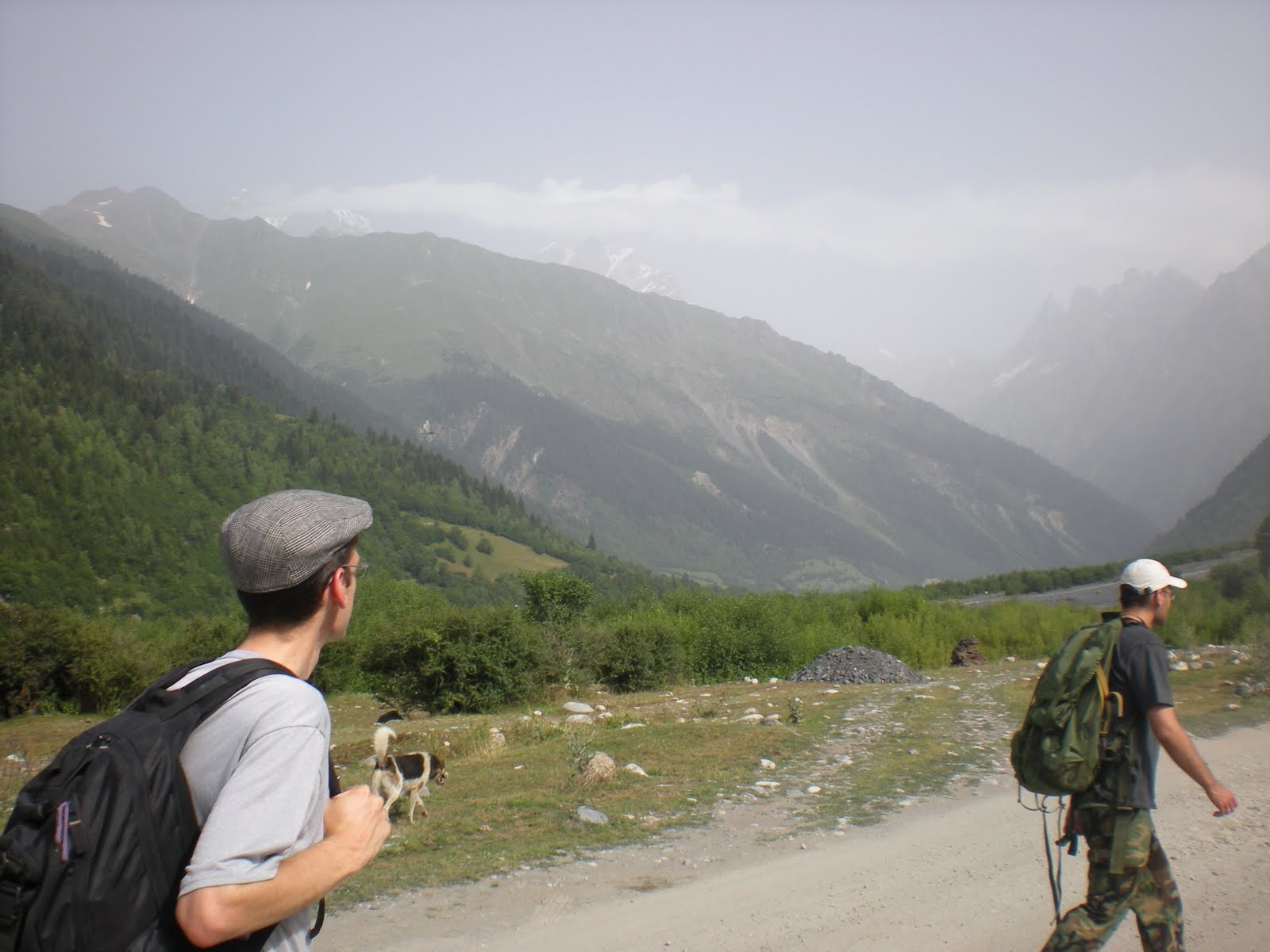
Our first glimpse of some tall mountains and the glacier
Gizo, contemplating the sturdiness of the bridge versus the velocity of the river

Almost up to the glacier


Glacier, up close

After feeling sufficiently cooled off from the icy breezes coming off the glacier and its river, we headed back into Mestia, past the airport that can only accept flights when the wind isn't too high. Despite the nearly 15 mile hike we had just completed, we were still feeling pretty fresh so we headed up to the Svaneti ethnographic museum, which consisted of a very confused and confusing tour guide and a typical Svan residence (complete with defense tower to protect the clan from raiders).

Maybe a little bit treacherous to climb up to the top level of the defense towers
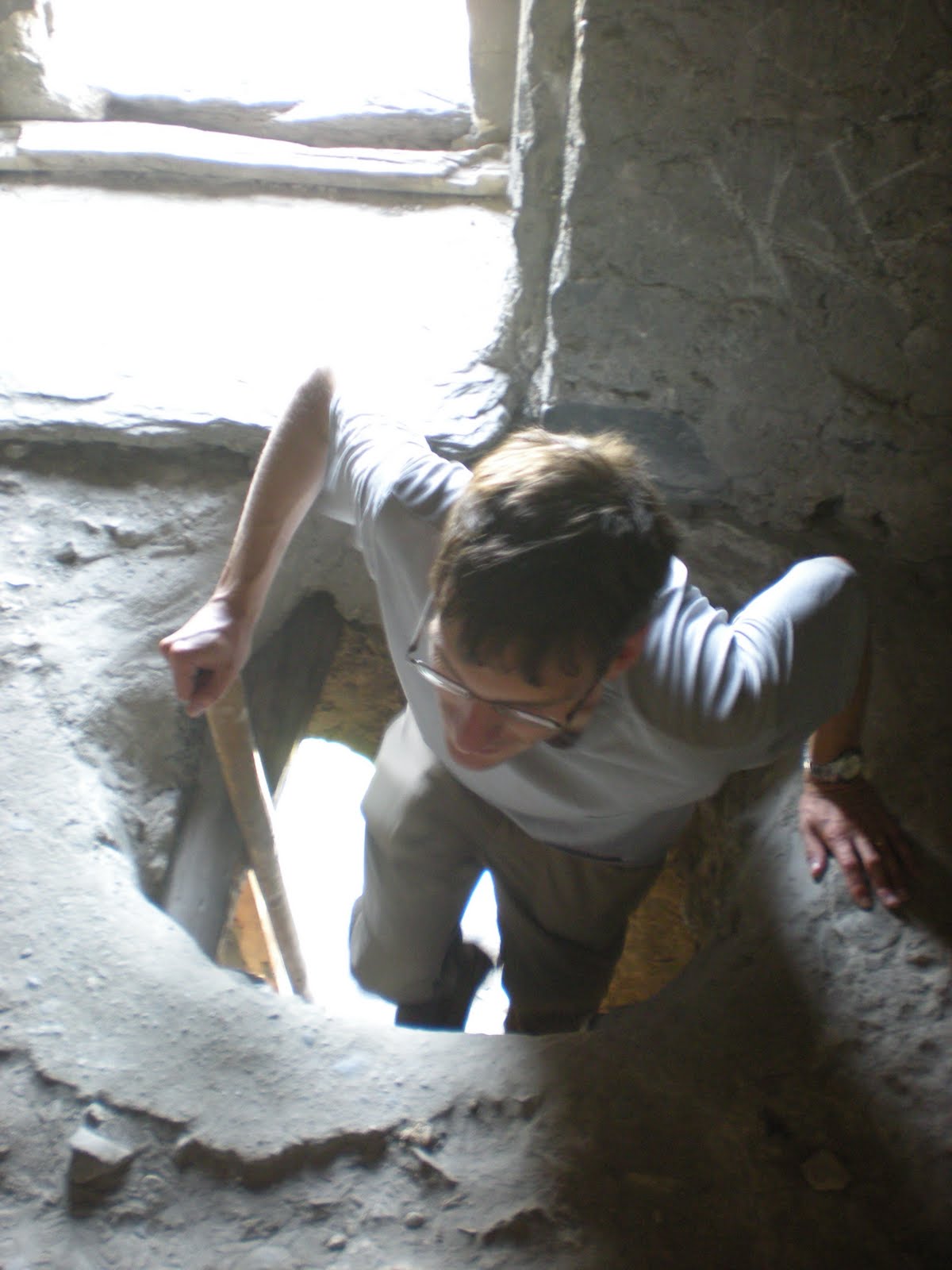
...but once inside, the view from the defense tower ain't half bad!

Back to the guesthouse at the end of our first full day, we plowed through another huge dinner consisting of lots of food in big quantities of deliciousness before crashing completely and sleeping blissfully. Even after just one day, we felt like the ordeal that was the car trip to Mestia was completely justified!

Thursday, August 4, 2011

Backyard camping

One thing about Georgia is that it makes you want to be outside. In this spirit, and in preparation for an upcoming trip to Europe on the cheap, we bought ourselves a tent. A quick test run in the yard brought all the children within shouting distance to see, and led to two more setups in the next 24 hours. It was a big hit with our host siblings. Shaen helped put it up (asking lots of questions about who lived in tents and where you could put them), and once Lilit got in, she refused to leave. We eventually dragged her out under protest.


Look! A camera *and* a tent! All at once!

Tuesday, August 2, 2011

Published Authors!

On Wednesday, July 27, Sam and I were invited to the official book release of a book called “Musings on the Cow, and Then Some.” This book was the brainchild of some of the PC Georgia staff and the U.S. Embassy in Georgia and is a compilation of blog posts and photos written and taken by PCVs in Georgia (from the G9 and G10 groups). This year is the 50th anniversary of Peace Corps worldwide and also marks 10 years of the Peace Corps Georgia program.

Inside the Palace of Youth in Tbilisi

The blog book (as we all informally called it while it was searching for a title) is really a cool thing. Sam and I had three different blog posts (and lots of pictures) selected for inclusion. We’ll get copies and bring them home to show off to everyone, and if we find that they end up being available elsewhere (pretty unlikely, I think, but they do have an ISBN number, so who knows?), I’ll be sure to let you know.

A pretty nice building, no?

The launch party for the book was really nice. It was held in the Palace of Youth in Tbilisi, a very cool building that I had walked past several times but never been inside. (It also turns out to be the building in which the Republic of Georgia declared its independence from the Russian Empire in 1918, as well as where the Republic of Azerbaijan did the same in the same year.) The U.S. Ambassador to Georgia, John Bass, attended the event with several Embassy employees. The Ambassador is a really wonderfully nice man and extremely knowledgeable, but also exceptionally busy, so for him to take time out of his schedule to attend an event like this for Peace Corps is always really fantastic, I think.

L-R: Ambassador Bass with his wife, me, my friend Marianna and PC Georgia Country Director, Rick Record

Each of the volunteers who contributed to the book were asked to speak a little bit about why they blog and what they write about. Afterwards they distributed books to attendees. Also invited to the event were several Georgian students and some other Tbilisians, who all swarmed us for autographs after the formal part of the evening was completed. It seemed a little funny, but I guess it’s something we’ll have to get used to as published authors.

Monday, August 1, 2011

Koda Children's Week

It's really been turning out to be a supremely busy summer here for us. This is really good, generally, because last summer we had a whole lot of time on our hands as we got the feel of our permanent site, got to know people and got used to not having every second of our time planned for us as we did during training. Now we're the old veterans in Peace Corps Georgia; almost all the G9s have departed for their next adventures (we miss them already!) and the G11s are officially sworn-in volunteers (they seem like they'll be a great group!). The clock on our PC service is slowly ticking down, and now with each remaining day we pass the last of that date we'll spend in Georgia as volunteers. We just finished our last July in Georgia. Today? The last August 1st we'll spend here in this run.

But time is a weird thing. It rushes and yet it still moves slowly sometimes (for instance, we do still have a lot of English classes to teach in the coming year, which will undoubtedly be like molasses in January), but this summer we've been rushing through the days. And since we've been so busy and been working on a lot of different things here recently, we'll have a flurry of posts over the next couple of days--great summer reading for anyone interested in that kind of reading, I guess.

Last week, fully recovered from my bout with food poisoning, I was in Tbilisi working with fellow volunteers Erin, Kelsey and Kaitlyn on a summer camp for kids at the Koda community center. Koda is a small village just outside of Tbilisi that occupies the territory of a former Soviet military base, hastily remodeled to house the people living there. It has a small population, about 2000 people, and almost all of them are IDPs (internally displaced people, almost like refugees, but people who don't cross international borders).

Koda

I posted a little about the IDP situation in Georgia earlier in our blog, but here's a little more info on the situation. Georgia has a large IDP population due to its civil war after the break up of the USSR as well as from the 2008 war with Russia. In this small country of about 4.5 million people, about 300,000 are IDPs. That's nearly ten percent of the population. Forced from their homes and homelands by war, strewn about the country in settlements with others in the same situation.

The people living in Koda are those who were forced to flee their homes in South Ossetia or Abkhazia during the 2008 war. This week-long camp I worked with there was really my first experience talking with Georgian IDPs. It was really incredible, hearing how calmly Madonna, the office assistant at the Koda community center, could talk about how much she misses her gardens and orchards in South Ossetia. Or watching the children play and laugh and act just like normal kids, even though they were forced from their homes when they were just a few years old. It made war and its aftermath seem supremely real and the human impact all the more difficult to justify or accept. At the same time, seeing the normality, watching how life moves on, being able to talk with people about it--the experience made me really see the resilience of people, of the human spirit. And it also made me realize how fortunate people in this community are to have the community center and staff they have, helping them pick up the pieces.

Children in the Koda Community Center

Khatia, the director of the community center, is a godsend for Koda. She has been working round the clock to put together great programs for children and adults in the settlement. The center has training courses for adults in various trades, helping people who worked primarily as farmers hone the skills necessary for jobs or trades in Tbilisi. There are lots of programs for kids, too, teaching the older students about leadership, computers and community service and giving the younger children a place to take music classes or do some art or just play with other kids. Khatia told us that more programs were possible last year because the center had more funding from a larger source, but currently the programs are doing a lot of good and helping out not only through training, retraining and education, but also by providing a lot of psychological assistance. One project Khatia told us about was an art therapy project for some of the younger children, recently completed, but with a follow-up to come. She and the staff at the community center (who are made up of both IDPs and non-IDPs) are really dedicated to helping people to move forward and heal and not be held back by the terrible circumstances that led them to this.

During a rousing game of Pictionary

Khatia was also the main driver of the Koda Children's Week, wherein she organized daily activities for children as a pilot run of a summer camp she'd like to keep organizing in Koda. Our part in the Children's Week festivities seemed relatively small. We met with the children in two groups, of "older" and "younger" kids for about an hour or an hour and a half each day, played games with them, taught them some English, gave presentations about America and just spent some time with them. They laughed at our Georgian, but appreciated when we tried and had a lot of enthusiasm (especially on the days when we brought in candy). Khatia and Madonna and the others at the center made it seem like we had done so much more, though. They kept showering us with thanks and making us feel really appreciated, when really, it was Khatia and her staff at the center that should get the thanks and praise. They do some remarkable work, and it isn't work that I can imagine would be easy to do.

Kids working on projects

...and discussing volunteerism

I'm really hoping that PC Georgia will be able to strike up a more formal relationship with the Koda community center in the future. We had a great experience working with the staff there, which is always encouraging. While my fellow PCVs and I are all planning to travel back to Koda in October (Khatia has organized a crafts fair of all the good produced by the adults in the training programs and has invited us), I think a permanent PCV posted to Koda could do a world of good and have a really positive experience, albeit a very challenging one.

Sick

Sam and I spent an unplanned week in Tbilisi right after our parents departure. We went into Tbilisi to see them off to the airport on July 11 and then headed back to Akhalkalaki for some R&R and project work before our next big summer plans and activities. Unfortunately, that week of rest and relaxation got hijacked by sickness.

I got pretty unpleasantly sick the night we returned to site and wasn't any better the next day (Tuesday). We called our PCMOs (Peace Corps Medical Officers, or Dr. Tamriko and Dr. Marina, as we call them) and they told us they wanted us to come in to Tbilisi for check ups to make sure it was nothing. The road isn't exactly a pleasant one to travel on when you're feeling your best, but at your pukiest worst, it's a real doozy. Luckily, they sent a PC vehicle to get us, which limited the bumps and definitely kept the grandmothers carrying large bags of unrefrigerated cheese to the lowest number I've ever had on a Tbilisi trip.

We're really fortunate at our PC post to have fantastic doctors who are, if anything, a little too cautious about our health and who mother us in a way that is really pretty comforting when we're sick so far from home. Drs. Tamriko and Marina took excellent care of me, kept me in Tbilisi for almost a week, and got me all back into shape, so I could tackle all of the projects and plans I have for the summer. Hopefully, with this case of "severe food intoxication" (as they called it) behind me, I can finish up the rest of service without any other issues!

Thursday, July 21, 2011

Georgia in 8 Days

We've had a busy, eventful few weeks since our last post. Just after the end of GLOW camp, my parents and Sam's mom came to Georgia to visit us. We tried to pull together a travel plan that took them to a lot of different, cool places while they were here without completely killing them with too much walking, riding and moving from place to place. (You can talk with them to see if we succeeded or not.)

Sam and I trekked out to the Tbilisi airport to meet our folks from the plane at 2:45am on Monday, July 4. Another volunteer, Alissa, was there too, awaiting her mom and sister, who happened to be on the same plane as our parents. Everyone got in safely, there were lots of hugs all around and all of the suitcases made it with the passengers (at least in our group--Alissa's family wasn't so lucky and had a day delay in claiming their bags). Our first experience in Georgia was getting a cab from the airport, which normally isn't any kind of problem or hassle at all. On this night, it wasn't too much trouble, but our cab driver was in a big hurry to go, so he packed up the trunk and shuffled us into the cab more quickly than things usually go here, all the while shouting at everyone to hurry up in at least 2 different languages that the majority of the people being rushed along didn't understand.

While the travelers were still fairly wired from jet lag and travel buzz, Sam and I immediately crashed back into sleep when we got to the hotel--we got to stay in the Courtyard Marriott in Tbilisi, which is super posh and felt like the finest quality hotel I've ever stayed in (such comfortable beds! An exercise room and pool! Fantastic shower with super great water pressure! Heaven!). A big thanks to my parents for using up their Marriott rewards points and pitching in the moolah to make that happen!

We spent the first three days of our trip in Tbilisi, wandering through the Old Town, going to some of the newly reopened museums, and eating delicious Georgian food at every opportunity. We rented out a private room in one of the sulphur baths to help ease out the kinks from longs hours of airplane travel and we took a day trip into the old capital of Georgia, Mtskheta.

On Wednesday night, we took a midnight train across Georgia to the Black Sea coast town of Batumi. We spent most of Thursday relaxing on the rocky beach, then went to the Botanical Gardens at the perfect time to watch the sun sink slowly over the sea. It was gorgeous, and I really think some of the views there are up there on my list of prettiest vistas.

About midday on Friday, we packed up again to head back to the middle of the country, to the Borjomi region to visit with our very first host family in Kortaneti. It was in Kortaneti that our parents got their first real taste of Georgia; Maia and Zurab (and all the neighbors) had the table all set for a supra. There was a lot of eating, toasting, drinking, laughing, talking, translating, and pushing to eat more and more throughout the night. It was really something that, although we've explained the supra to people and talked about it here in our blog, you really have to experience getting supra-ed to understand it. The hospitality and the genuine joy at having guests and the effort that goes into preparing the spread... it's hard to do justice to it all in words.

On Saturday, we spent some time wandering around Borjomi park, riding the cable-car gondola up to the top of the hill for some better views, riding the ferris wheel for an even higher-up vantage point, and hiking back down. We then set off to the south, in the direction of our permanent site, nestled between the borders of Turkey and Armenia. Since we were passing, and since any traveler to Georgia with the time should see it, we stopped at Vardzia, the 12th century cave city in our backyard. It was hot as we hiked up the hill to get to the caves, but the general consensus was that it was worth the toil. We came back down the hill through the tunnels and winding "stairways," which brought us ever so close to being disowned by our parents. Although we had assured them that the way down wasn't too difficult, they begged to differ. All survived in one piece, though, and at the end everyone was glad to look back up at what we had just done and exclaim at how "we were up there! And we made it back down alive!" So I'll just paraphrase everything else and say a good time was had by all.

After a long day of lots of hiking and climbing and driving (including a climb in the car up to the top of the plateau, to an elevation of about 1600 meters), we arrived at site, to our host family's house in Akhalkalaki. Although there are hotels in town, our host family insisted that it would be fine and more comfortable and easier and nicer for all if we all just stayed with them at their house. You really could say that for their last two days in Georgia, our folks got a chance to really see what our experience here has been like. We were again treated to lots of amazing food and drink (this time with more of an Armenian twist--no khachapuri, but lots and lots of dolma). During our time in Akhalkalaki, it was more about visiting (and being treated to an ever increasing amount of various foods and sweets and drinks) than site-seeing, which took its toll and tired us all out in a very different kind of way.

On Monday the 11th, we took our last long journey across Georgia all together, this time in the form of a marshrutka (mini-bus) ride to Tbilisi. We ate some last Georgian foods, bought some souvenir wine and then packed our parents into a taxi back to the airport. Then we headed back to site to unwind and settle back into our summer routine, grateful to our parents for making the trip, for putting up with our long and winding itinerary, for their patience in trying different foods and dealing with different languages and translations, for their generosity in taking us out to some nicer meals and hotels and sites than we usually manage and for all of their love and support that makes it possible for us to go off on such wild adventures. Thank you!

(And for those of you wanting pictures from this trip, you'll have to put pressure on the parentals... Sam and I gave our shutters a rest, since the three of them were snapping away. Or, do Moms or Dad want to do a guest post about your reactions to the trip and to show off some of your pictures?)

Sunday, July 3, 2011

GLOW Camp


I spent last week in the Kakheti village of Apeni working as a counselor with four other PCVs and 4 Georgian college students to oversee 28 Georgian girls, aged 13-16, for a 4-day camp called Girls Leading Our World (GLOW). GLOW is an international Peace Corps initiative that had been active in Georgia prior to the 2008 August war. My fellow PCVs were really motivated to get it restarted and have been extremely successful in their efforts. I am extremely proud to have been able to work with such talented volunteers on such a great project.

In the village of Apeni

The idea of GLOW camp is to give girls opportunities to learn leadership and teamwork skills, talk about gender roles and gender issues in their lives, study some basic health topics, and exercise. In the mix is a lot of fun and a whole lot of silliness. Everyone learned a lot and the girls made a lot of new friends.

Girls working on a "Team Flag" for my small group

Playing "Human Knot" as an ice breaker for the teamwork session

Listening attentively to one of the opening presentations

We started each day off with an hour of exercise, with each counselor leading a different "class." Heather taught yoga, Lauren took the girls running and played some running games with them, Samantha also led some games and walked with the girls and I led a class we called circuit training, which was fairly similar to what I do with my women's fitness club. After exercising, we met as a large group for an opening, where our Georgian counselor-counterparts gave short presentations on famous and successful Georgian women. Then we broke into small groups to discuss topics like peer education, hygiene, gender roles, leadership, etc. On Thursday morning we had a guest lecturer from a women's health NGO in Tbilisi, HERA XXI, come to talk with the girls about women's health, puberty and reproductive health and HIV/AIDS. Georgian schools don't include health education in the curriculum, so it's very hard to get reliable information on these types of topics, especially in villages. At lunch time, a local woman made tons of khatchapuri and lobiani and we ate cucumber and tomato salad before heading back for more sessions. In the evenings, we met back up for fun activities, like a scavenger hunt, talent show and dance party.

The talent show was a big hit!

I wasn't involved in any of the planning for GLOW, but just came in for the actual event to help lead one of the small groups (we broke the girls into 4 small groups to facilitate discussions when we weren't in the large group). The PCVs who did the planning (Kelsey, Heather, Samantha and Lauren) had been working on setting things in motion for the better part of a year. EVERYTHING was so well planned that I had no trouble stepping immediately into the role of counselor with no planning on my part. Each counselor was paired with a Georgian counselor counterpart (4 terrific girls who are all studying at Tbilisi State University). We worked as a team to lead conversations and discussions in our small groups, and our Georgian counterparts were hugely important to getting everything translated, clearing up questions and making discussion possible. Also, they were just really cool girls.

Writing compliments to one another during the self-esteem session

By the end of the week, when it was time to head home, our campers were begging us to stay longer, to add extra days to camp, exchanging phone numbers and email addresses and promising to friend one another on Facebook. We took that as a good sign that camp was a success. But even though GLOW was wonderful and went very smoothly, it wasn't nearly the kind of camp initially envisioned by the PCVs planning it.

Prior to the war, GLOW Georgia had been a big affair--more than a week long with 80 campers staying at an all-inclusive campground/conference facility of sorts, drawing in guest speakers like the First Lady of Georgia. GLOW in Armenia is similarly large scale and big budget. Our four PCVs shot for the moon in their restart attempt and were ready on the organizational end for such a big endeavor. Unfortunately, though, the funding just didn't come through. GLOW had previously been funded through U.S. Embassy grant money in Georgia (and continues to be thus funded in other countries frequently), so our PCVs were advised that they shouldn't have any problem also receiving funding. But cuts in U.S. foreign aid and changes in priorities for channeling aid money meant that GLOW's hopes were almost extinguished.

Thank goodness for the persistence and creativity of Peace Corps Volunteers.

Samantha, Heather, Kelsey and Lauren were not about to give up when their funding attempts fell through. They kept at it, writing different grant proposals, tweaking the schedule, cutting the size and length of the camp until it was finally possible to pull it all together.

Heather and Maka getting one of the large sessions started
We had 28 campers who came to the village of Apeni. 9 of the girls were from Apeni itself and hosted other girls from other parts of Kakheti in a homestay-sleepover type of setting. Their homestays were each paid a small stipend per girl and were expected to feed the girls breakfast and dinner each day. The camp itself was held from 9:00am--10:00pm at the school in Apeni. We bought lunch and had it at the school each day. The initial grant would have covered housing the campers and counselors in a campground facility that would have taken care of food and everything else needed. It would have also allowed us to include girls from a wider portion of the country. As it stood though, the grant the they finally received was about a tenth of that originally requested, so homestays were necessary. In order to keep the camp completely free for the campers, we could only accept girls from Kakheti region (otherwise, transportation costs for bringing the girls would have spiraled out of control and above budget). The grant that ended up funding GLOW was a real life saver and allowed the camp to happen, but was more limited than the ones originally hoped for.

Lots of talented girls performed during the talent show

The PCVs working at the camp stayed with Kelsey at her host family's house, a half mile walk from the school. That doesn't seem too far away until you deal with walking back and forth several times over the course of the day in 90-degree+ heat carrying odds and ends of camp equipment. We weren't allowed to use any of the grant money we received to pay for anything for ourselves, so our transportation to Apeni, our food, and anything we needed for the week we funded ourselves. We were also sad that we couldn't use funds from this particular grant to get the girls t-shirts or some other giveaways (and really we wouldn't have had enough money for it anyway). But even though we had to pay to work at the camp, the girls (and our fantastic Georgian counterparts) all got to attend for free. Also, the main goal to restart this excellent girls' leadership camp in Georgia after a 3-year hiatus has been achieved, which is the most important thing for now.

GLOW was a huge success, even with its budget constraints, slashed numbers and shortened program. Right now we all are taking a big deep breath and sigh of relief that it's all wrapped up and finished for this year, but soon we'll start planning again for next year's event. Hopefully the base we've built this year will make it possible to go bigger and grander next year!