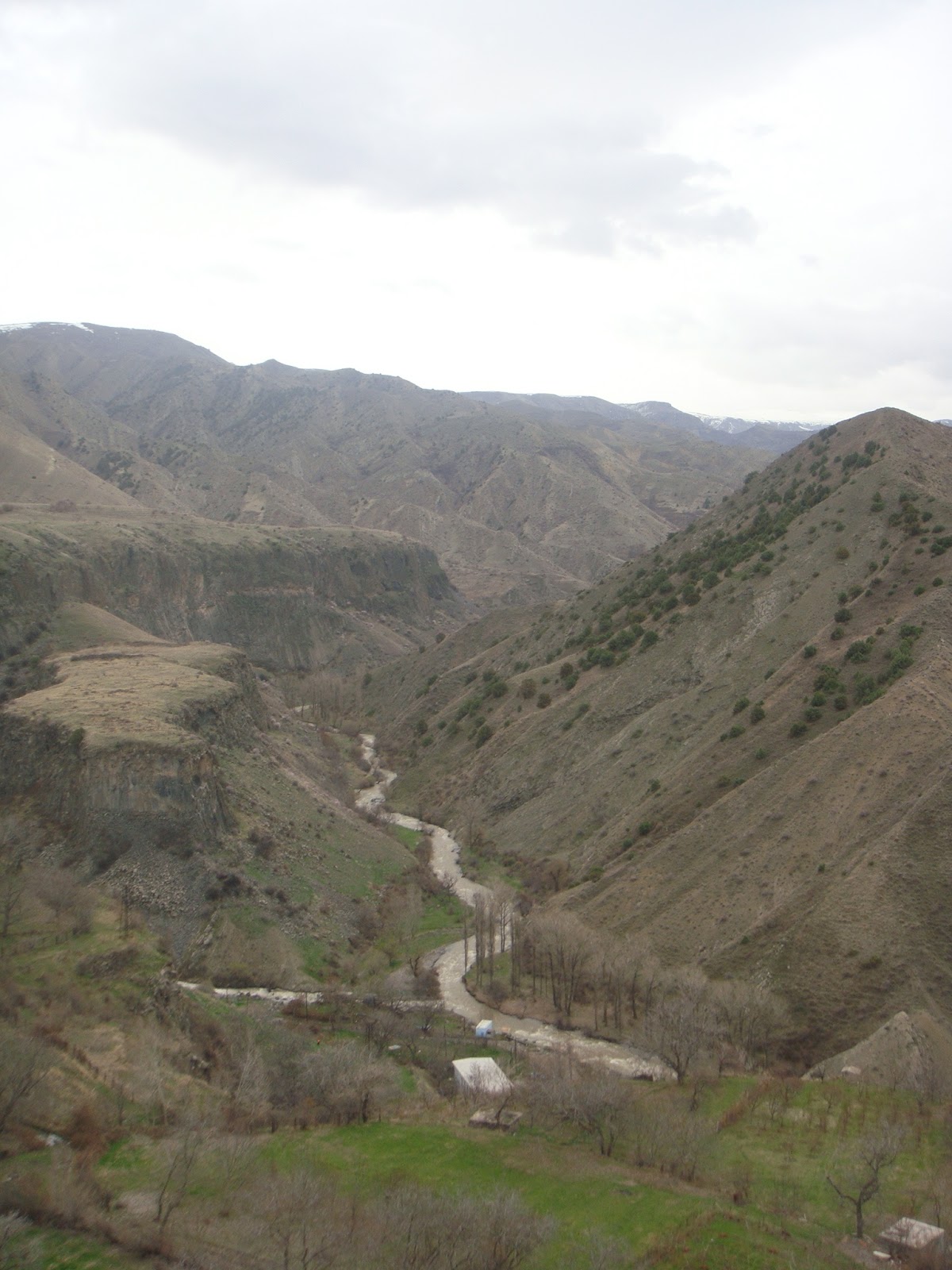
Khertvisi Castle, Khertvisi, Georgia

Tuesday, April 24, 2012

Spring Break Armenia, Day 3

Khor Virap


Our third day in Yerevan broke clear and bright, and we decided to go on another excursion out of town.  This time we took a bus and headed south to a monastery situated smack dab on the Turkish-Armenian border.  Khor Virap is the name of the monastery, which literally means "deep pit."  Sounds lovely, doesn't it?  Well, it's so named for it's biggest feature, two deep pits under one of the chapels, in which Grigor the Illuminator was imprisoned by the Armenian king for 13 years.  It's a long story, and involves the king of Armenia either going crazy or having his head turned into the head of a boar, but eventually the king let Grigor out of the pit, and got himself all baptized and Armenia became the first officially Christian nation, in 301.  

The Yerevan train station, from whence our bus to Khor Virap departed

Self portrait in front of all the loveliness that's visible in the top picture.  Unfortunately, it turned out looking like we just take self portraits in front of fields of dead wheat.

But once we stepped away, this was the view again.  Pretty!

Now they have ladders to climb down into the pit, which is great because you don't get stuck down there for 13 years.  

Sam made it back out in way less than 13 years

Khor Virap up closer

The main church building at Khor Virap


So Khor Virap is an extremely venerated and important church/monastery for the Armenian church.  It's a big draw for pilgrims or visitors looking to climb down into Grigor's pit and light some candles in the church.  But it isn't just the religious that draws folks to this place.  Khor Virap is situated on a hill just a stone's throw from the Araxes River, which winds along the bottom of the mythical Mount Ararat (the big snow covered mountain you see in the picture).  Ararat is a dormant volcano peak, a very tall 5137 meters or 16,854 feet. It's also the mountain on which Noah's ark is said to have come to rest.  Ararat is much taller than any of the other mountains in the area, and on clear days is visible in all kinds of parts of Armenia.  It dominates the Yerevan skyline.  Mount Ararat is the symbol of Armenia, and many, many Armenian households have the same painting of Ararat's greater and lesser peaks (Masis and Sis). There's a catch, though: Ararat may be revered and celebrated by Armenians as their symbol, but it now lies within the territory of Turkey.  The Araxes River basically forms the border between the two countries, closed acrimoniously since 1993 (as a Turkish response to the Armenia-Azerbaijan war in Nagorno-Karabagh).  So Armenians come to Khor Virap for just about their closest look at the mountain that has come to hold so much meaning in their culture.  It seems to me that having the mountain just across the uncrossable border has probably done a lot to make it a more important symbol, and has endowed this place with stronger emotions and hatreds than would otherwise be the case.  This is a big, big mountain, visible everywhere.  Having it just out of reach makes it a something that's easy to grasp in a different sense, as a symbol of all the perceived injustices and the heights they reach. 

Very Soviet-esque statue near Khor Virap.  Looked a little like Stalin as a mountaineer.


Once we'd had our fill of traipsing around the countryside, we hitched a ride back up to the main highway.  It was about 5 kilometers from the highway to the monastery, and while we were prepared to walk the distance, we didn't turn down the offer of two young men who pulled up alongside us and offered us a lift. They were extremely nice and excited that we spoke Armenian.  As we approached the highway, they began to apologize profusely that they couldn't take us all the way into Yerevan.  They wanted to, and would gladly, except that they didn't have driver's licenses and didn't want to risk driving on the main highway and getting stopped.

We said our goodbyes and waited alongside the highway for the next passing bus or minibus to take us back into town.  It wasn't long before one pulled up and we were back to Yerevan.  As we pulled in, Sam's eyes lit up at a sight we passed: a pretzel shop.  Pretzels!  Sam, as you may know, loves soft pretzels.  It's been one of the things he's missed most here.  So what did we do for lunch?  You guessed it: soft pretzels.
Is that joy, or what?

Best day ever.


The rest of the day pales in comparison to soft pretzels, for sure, but we did get some cool pictures out of it.  We wandered through the displays in the puppet theater, looking at the puppets, walked through town some more, ate really delicious khorovats and checked out a cool new-ish monument to an old Soviet movie.

Some of the puppets on display

The puppets really remind me of a lot of the Soviet cartoons and stop-motion animation movies

Hanging out with "The Men"

Monday, April 23, 2012

Spring Break Armenia, Day Two

Garni Temple

On our second day in Armenia, Sam and I took a day trip out of town to see some other sights.  We headed to the pagan temple at Garni and the Armenian Christian monastery at Geghard, both about 30-40 minutes' drive from Yerevan.  We were joined on our tour by our host grandmother's cousin, Alexander.  He's an engineer in Yerevan, and speaks English (and Esperanto!) fluently.  He was excited to meet us after talking with Emilia (and us) a lot on Skype.  It was nice to have a local travel with us.

We had worried that the weather might not be too good for a jaunt into the countryside, as the grey clouds covered Yerevan all morning and little outbursts of rain kept us on our toes.  We lucked out, though, and the rain not only held off, but the skies cleared and we ended up with a fantastic day for wandering around old ruins.

Our first stop was to Garni, an ancient pagan temple turned summer palace for the later Christian kings of Armenia.  There are other ruins (of an old Armenian church, and other structures, like baths) around, but the main focus is the temple structure you see above.  The landscape around Garni is really something, too, and once all those trees and flowers get into full bloom, I'm sure it was really striking.


The scenery around the Garni temple was just coming alive, but still breathtaking.  We imagined that in another few weeks, after more buds had burst and green taken hold, it would truly be beautiful.

Not the most successful of self portraits, but you get the idea.  We were there.

This is where the archaeologists stayed while excavating.  Sam's setting himself up for the good life!


Our next stop was to the Armenian monastery of Geghard.  The original site was founded by the founder of the Armenian church (and converter of the Armenian kings to Christianity), Grigor the Illuminator.  The complex had the whole 9 yards: monastic caves, khachkars, a big ol' church, holy spring, courtyard, place for animal sacrifices.  You name it, they had it.  It was also just a really pretty, pleasant place to be.  The church itself was incredibly cool inside, and it turns out that's not odd.  It's main structure is apparently carved out of a single piece of solid rock from the side of the mountain it nestles against.

Monks gotta have their caves!

Lots of very cool old khachkars everywhere

 Sam really liked the beehives, especially after he made friends with one of the bees

Inside the main church building

Lots of cool stone carving going on

It was pretty dark inside, though, with the only light making it in through the ceilings and a few darkly colored windows

Geghard Monastery

Sam with some khachkars

I moved just as Sam was surreptitiously taking this and made his picture come out blurry

Some of the very old khachkars had been painted red, and still had traces of the red paint

Outside the monastery, lots of women from the neighboring village were selling their goods: gata, pastegh, and churchkhela

As we approached, they all tried to entice us with their goods

We made it back to Yerevan in the late afternoon, happy with our side trip and ready to eat more food, of course!  We tried out the Indian restaurant in Yerevan, which was delicious, and then got some ice cream to snack on as we strolled around the park near our hostel.  There were lots of kids out biking, roller blading, and generally running around, enjoying the weather and the freedom to no longer be bundled up in winter clothes.  The park was starting to get all set up for warmer days, with games and attractions popping up like crocuses.

This was the game I wanted to play, if only to try to win the stuffed John McCain doll in the right-hand corner.  Unfortunately I didn't have any 100 dram coins on me.  Next time, John.  Next time.

Saturday, April 21, 2012

Spring Break Armenia, Day One

Around Georgian Easter, we got quite a nice break from school. Our schools were closed from Thursday through Tuesday, with an extra day off the Wednesday before for "spring cleaning."  Sam and I decided to take advantage of the break to use up the final vacation days we'd acquired and see a little bit more of Armenia.

We were planning to take one of the plethora of minibuses headed for Yerevan on Wednesday morning, only to make it to the station just as one bus was leaving and the next not yet arrived.  This sent the bus station taxi drivers into a frenzy, as they all swarmed around us trying to entice us to ride by taxi instead of waiting on the next marshrutka.  Once one driver finally agreed to charge us each the same price as a minibus ticket (20 lari, about $12), we climbed on in, shocked at our good fortune.  Of course, we should have realized that he wouldn't just take us, but would wait around for 2 more passengers to cram into his little hatchback, and we should have realized that he'd try to charge us more when we arrived in Yerevan.  We should have known this by now.  But, in a shocking twist on fortune, we got there quicker and with fewer bags of potatoes and cheese, and managed to haggle our way back to our initially agreed upon price, so all in all it was an auspicious start to the trip.

Armenia's weather is generally warmer than Georgia's (it being south and all), and Yerevan was in full swing spring.  Grass was growing (and green!), flowering trees and bushes were all starting to show there colors, and outdoor cafes were already up and bustling.  We checked into our homestay/hostel, shed a few layers and headed out into the city to do some walking around and site seeing.

Our previous trip to Yerevan took place in January, so we had already seen most of the museums and indoor attractions, but Sam was excited to check out the ruins of the Bronze Age Erebuni fortress just on the outskirts of Yerevan.  That was our first stop, along with the accompanying museum.

Day one was rounded out with some lachmajun, some tan, some other tasty treats, and some nice long walks along the pretty downtown pedestrian boulevards.  We had some nice conversations with our hostel/homestay host, Anahit, and called it a day.  Vacation success all around!

Remains of the Erebuni fortress wall

Me, getting excited about mud brick (and being super supportive of Sam's future academic pursuits)

There were some cool cuneiform slabs here and there throughout.  Once Sam's progressed a bit into learning cuneiform, I encourage everyone to take pictures like this and send them to him, asking "What does this say?"

A chariot found in the fortress excavation

One of the guys who did something with the fortress or something, I think.  Whatever, he's standing on a lion.

A model representation of Erebuni.  Sam really likes these kind of models and hopes to make some like this some day.  But preferably out of legos.

In the museum they had some more old cuneiform tablets...

Which were later repurposed by Armenian Christians into khachkars on the reverse sides

A very Soviet-inspired facade to the Bronze Age fortress museum, no? 

After our visit, maybe Sam could join the junior archaeologists' school!


Tuesday, April 17, 2012

Easter Celebration

I'm a little late updating from Easter, although the other PCVs in Georgia might not realize it. The Armenian church celebrated Easter at the same time as the non-Orthodox Christian churches (Catholic, Protestant, etc.), so last week, on Sunday, April 8 we celebrated Easter in Akhalkalaki. Orthodox churches celebrated this past weekend, on Sunday, April 15. Last year, the two branches of Christianity celebrated Easter on the same day, April 24, but this year there was a week difference. Here's why.

Since last year we were off doing other things during Easter (like going to my little sister's wedding!), this was our first time seeing the celebrations in Akhalkalaki. It's some pretty cool stuff, with some shared traditions and some very different traditions.

Last Easter
First, on some shared traditions, we've got egg dying. In Georgia, as in many parts of Eastern Europe, the traditional color for dying eggs is red. Here in Akhalkalaki, they use either onion skins or some kind of red-colored root (whose name I didn't recognize) to dye their eggs. In other parts of Eastern Europe, they use beets. The brightly colored eggs and shrink wrappers of my childhood are still sometimes found here (the kids especially love these kind of eggs), but most people still stick with the traditional red for most eggs.

Shaen and his grandmother, Emilia, prepare the eggs for dying
They wrapped pieces of parsley around the eggs, then held it in place with old pantyhose, to make cool designs on the eggs
Getting ready to dye
Some of our host family's finished eggs

Dying the eggs isn't the only fun part of Easter eggs in Akhalkalaki and Georgia, though. On Easter, people choose their favorite egg (or one that they decorated) and do battle. They crack their eggs against one another to see whose egg will stand up to the test (and thus, who will have good luck in the coming year, plus bragging rights, of course).

Akop, Armine, and Shaen try to explain the game to Lilit
Once she got the idea, she started off on a rampage, cracking all the eggs she could get her hands on against one another

Shaen's friend, and our neighbor, David, came over to test out his lucky egg against Shaen. The first victory went to David, but on the other end of the eggs, Shaen had the upper hand.


There are a lot of other similarities in some of the non-religious Easter symbolism, with chicks, ducks, and bunnies ruling the decor. Our host family really got into the season by purchasing a battery-operated chicken that plays a really annoying song while walking and then laying eggs. It's been great. Really. I love having it around. Seriously. If no pictures or videos of it appear here, I swear it has nothing to do with any kind of sudden, unexpected disappearance. Really.

Some cute table decorations that don't play annoying music

And of course, like any good holiday in Akhalkalaki, Easter also comes with doing up a big, fancy tablescape of decorations and food. One of the must-have foods of Easter is a sweet bread, laced with raisins and dotted with sprinkles. Another is Armenian gata (which in Akhalkalaki is made with a savory filling instead of a sweet filling, as it's done in Armenia). Our host family also says that they also always eat fish and rice pilaf for Easter. Our pilaf was a special ghapama, a tasty treat that Sam and I have been really fortunate to enjoy here many times.

The table transforming into an Easter table
Some Easter gata and ghapama
More Easter decorations (including one egg that Lilit got ahold of)

There isn't a tradition of having the Easter bunny come and hide eggs for good little boys and girls here. I really like the Easter bunny, though, and we decided to share one of our favorite Easter traditions with our host family as well. Sam and I didn't have any plastic eggs to fill with candy, but really wanted to have an egg hunt for our host siblings, so we improvised. Our "eggs" were just plastic baggies filled with candy and color coded with post-it notes to keep straight whose goodies were whose, but the spirit of the thing was there. We explained everything to a very excited Shaen, who helped keep the others in line for the hunt.

Our improvised plastic eggs, hidden for the Easter egg hunt
Shaen, searching out the last of his "eggs"
Lilit was really most excited about showing off her loot to her grandmother and me after the egg hunt finished
Shaen and Amalka preferred to go through their loot in privacy, though

In all, it was a really nice holiday filled with lots of food and good times with our host family. Not so dissimilar from a holiday at home, really. And, although the message may be a little late (and the video sideways), Lilit has something to say to all:

Saturday, April 7, 2012

Yet another day in the life

We've had some talk on the Peace Corps Georgia Facebook group about trying to give a rundown of a typical weekday-in-the-life. We've done a couple of "day-in-the-life" entries before, but here's another one. This is how a typical March Thursday might go for Sam.

7:40 am - Wake up to alarm and go for a run with Melissa. We've been pretty consistent about this, but the winter was tough. We usually run 3 miles, braving snow and ice, mud, cars, bewildered pedestrians, cows, and (especially) angry dogs. We have three usual routes, straight out and back along the highway leading to the Turkish border, out the dirt road toward the village of Gumbordo, or down and up the hill toward downtown. Along with the mud and the slowly melting mountains of snow, the spring has brought my favorite hawk back. He sits in a tree just about the point where we turn around.

8:15 am - Stop at the bakery for bread. Roughly 50% chance of bread on any given day, depending on whether we get there before or after the guy fills up his car to go sell the bread elsewhere. Glasses fog when I go inside, but it smells really good.

8:20 am - Back home, try to force myself to do push-ups and sit-ups; clean up as best I can and head out to put on water for tea.

8:30 am - Breakfast is tea and oatmeal, with a piece of bread to sop things up, because how can you sit down to a meal and not have at least one hunk of bread?

9:20 am - Head out to school; it's a 20-minute walk the way I do it, which is more like moseying. Listen to a German or Russian lesson or music on the way.

9:45 am - Eighth grade class starts. This is my most difficult class. Terrible textbook apparently assembled by Dadaists, originally 40 kids finally split into two groups of 20, but still too many. In general we have 3-5 girls crowded up at the front paying attention, and the rest of the class busy with cell-phones, origami frogs, and so on. I have real difficulty getting my own parts of the lesson in, and too often, sad to say, I do next to nothing in a given class period. That makes the successes--a lesson on family trees, a "Wheel of Fortune" game--all the more rewarding, but, on any given day, odds are that this is a rough one.

10:30 am - First grade class. We've got some characters here: a little wiggle-worm dude who I don't believe has sat still for 10 seconds since birth; twins who have obviously picked up that it is cute when they scratch their heads and rub their chins when called to the board to point to a picture of a car; a know-it-all girl who is continually screaming out answers, which are half the time wrong; a really studious little guy; a girl who ought to be in the gifted class; and the girl who mostly stares at her shoes. My counterpart for this class is really good with the little ones, and we do a lot of games and activities. We've hit a bit of a plateau with the alphabet, so I'm trying to work in some more conversation.

11:10-11:20 am - 10-minute break. Try to read, or sometimes practice my Armenian with the other teachers. One vice-principal in particular has made it her mission to get me to speak Armenian, which is all the better for me.

11:20 am - Fourth grade class. 18 kids crammed into what ought to be a supply closet, and when the windows are closed and the heat's on, it's a heady experience. Although the kids have some real discipline issues, I think I like teaching in this class best--of all my classes, I have the most responsibility and am the most active here. I earned some credibility with the kids for teaching this class alone for a couple of weeks last semester when my counterpart got married, and for some reason I can speak Armenian with them ten times better than any other class.

12:05 - Twelfth grade. It was pretty early on this year that we learned the word "Senioritis." It's a pretty relaxing class to end the day with, since we more or less sit down and try to do conversation, but it's frustrating that they're not willing to take any risks with English and just turn to my counterpart to translate for them (and more frustrating that she continues to do so). Most of the kids are good and checked out of school already, and, to be honest, by the end of a long Thursday, so am I.

12:45 - Finish up; plan quickly with counterparts for next day

~1:30 - Get home. Relax and read for a little bit.

2:00 - Have something between a snack and lunch; usually a cup of tea and buckwheat, vermicelli, or beans.

2:30-3:15 - Play guitar if our host sister isn't sleeping, check the computer otherwise. Make sure I have all my ducks in a row for the eco-club. Melissa usually comes in just about as I'm coming out. Thursday's a coming-and-going kind of day.

3:30 - Eco-Club. I work with a friend and her mother to put this on; it's become something rather different than my original intention, with children much younger (1st-graders mostly) than I had expected. Because most of them don't know Russian well, and because my Armenian is not at a level where I can speak intelligently about the environment, a lot of the work is left to my counterparts here and I'm there for moral support, computer games, and films.

4:45 - Get home. Play guitar, read, write, fool around on the Internet. Do the written part of my German lesson; try to read some Russian. Melissa heads out for her fitness club around 5:30.

6:30 - Dinner. Our host dad has been working late, which means it's often just me, Melissa, and our host grandmother eating, but we'll be eating more as a family as the spring comes on and a lot of his clients at the pharmacy will be back to work in the fields.

After dinner, I try to sit out in the common area while reading or preparing. Lately, grad school and travel plans have meant a lot of Internet time, and this (as well as plain old fatigue) has meant more time in the room. Often Melissa and I will watch a TV show. If my host brother has English homework, I'll sit and work with him for 45 minutes or so.

10:30 - Tea. A host family tradition, but lately it's been just Melissa and I drinking, because the Armenian soap operas are running later than we go to bed, and they don't want to have tea until the shows are over. When we do sit down as a family, it's a good opportunity to talk and catch up.

11:00 - To bed.